
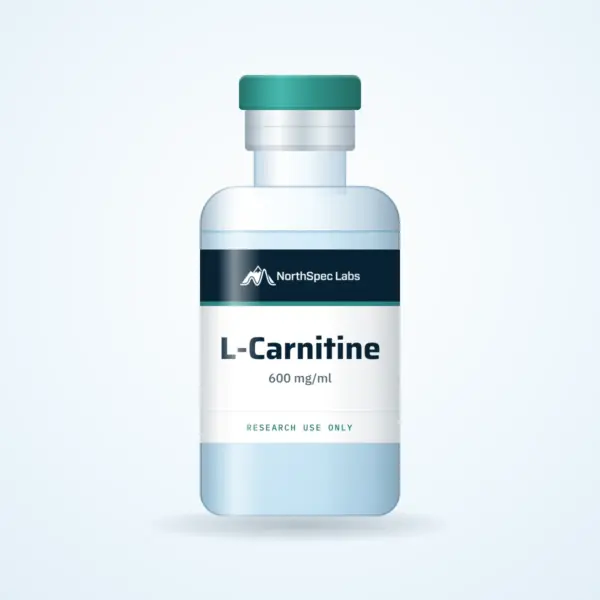
Buy L-Carnitine 20 ml in Canada
NorthSpecLabs sells L-Carnitine in Canada in 20 ml vials, for laboratory research use only. The main points are in the table, and each one links to the detail further down the page.
| What it is | Compound that carries fatty acids into mitochondria |
|---|---|
| Research on this page | 3 topics, 10 references |
| Size | 20 ml |
| Purity and lab report | [TO CONFIRM: from the supplier] Details |
| Delivery | Canada Post, usually 2 to 10 business days, from our Canadian facility. Free shipping from $250. Storage, handling and shipping |
| Tool | Peptide calculator |
What is L-Carnitine?
L-carnitine is a naturally occurring compound, not a peptide[1]. The body makes it from the amino acids L-lysine and L-methionine, and it is also found in foods such as red meat, fish, poultry and milk[2]. PubChem also lists it as levocarnitine, (-)-carnitine and vitamin BT[3].
Most of the research cited on this page was done in people and concerns L-carnitine taken by mouth as a supplement. One study used acetyl-L-carnitine, a related compound, and the page says so where it appears.
How L-Carnitine works
L-carnitine carries fatty acids into the mitochondria, the parts of cells that produce energy, so that the fatty acids can be broken down there (beta-oxidation)[1]. A 2011 review describes this as what allows cells to break down fat and get energy from stored fat reserves[2].
The body keeps its carnitine pool through food, its own production and the kidneys, which reabsorb most of the carnitine they filter[1]. Carnitine deficiency can be primary or secondary; for example, patients on dialysis can develop a secondary deficiency because carnitine is lost through the dialyser[1].
L-Carnitine research applications
Most studies cited here were done in people, including meta-analyses of randomized trials. They mainly tested L-carnitine taken by mouth as a supplement.
Body weight: two meta-analyses
A 2020 meta-analysis of 37 randomized controlled trials with 2292 participants found that L-carnitine supplementation significantly decreased body weight, body mass index and fat mass, with an average difference in body weight of 1.21 kg[4]. It found no significant effect on waist circumference or body fat percentage, and the authors described the effect as modest[4]. An earlier meta-analysis of nine trials with 911 participants also found more weight loss with carnitine than with control, and found that the size of the effect decreased over time[5].
Exercise and muscle
A 2020 systematic review of 11 studies in healthy people taking L-carnitine by mouth for 12 or 24 weeks found that L-carnitine together with carbohydrates raised the carnitine content of skeletal muscle[6]. It also found that supplementation raised fasting blood levels of trimethylamine-N-oxide (TMAO), a compound suspected of promoting atherosclerosis (hardening of the arteries), and called for longer studies of effects on the heart and blood vessels[6]. A 2018 review reported that L-carnitine supplementation reduced markers of muscle damage and muscle soreness after exercise[7].
Acetyl-L-carnitine in liver disease
A 2008 randomized, double-blind, placebo-controlled trial tested acetyl-L-carnitine, a related compound, for 90 days in 125 patients with cirrhosis and minimal hepatic encephalopathy, a disturbance of mental state and nerve and muscle function in liver disease[8]. Compared with placebo, it led to greater reductions in blood ammonia and to better results on tests of mental function[8].
Open a topic to read what the studies reported. A number in square brackets points to a source in the reference list at the end of the page.
L-Carnitine purity and certificate of analysis
A certificate of analysis (COA) is the lab report for one batch. It lists the tests done on that batch and their results.
[TO CONFIRM: purity, test method and batch certificate of analysis for this product, from the supplier. Once confirmed, this section shows the batch number and a link to the lab report.]
See also the lab reports (COA) page.
Why buy L-Carnitine from NorthSpecLabs
- Every research statement on this page is tied to a published source, listed under References.
- The page says whether a study was done in cells, in animals or in people.
- Orders ship from our Canadian facility to every province and territory, with free shipping from $250.
[TO CONFIRM: third-party testing and a lab report for every batch. These points are added here once they are confirmed.]
Related: Metabolic peptides, lab supplies and the Learn pages.
Storage, handling and shipping
Storage conditions for each batch are stated on the vial label and on its certificate of analysis. [TO CONFIRM: storage statement from the supplier.]
As general guidance for dry (lyophilized) peptides, the peptide manufacturer Bachem recommends storing them in tightly closed containers below −15 °C, and letting a cold container reach room temperature in a desiccator before it is opened. Bachem also notes that long-term storage of peptide solutions is not recommended[9].
To work out the concentration of a solution, use the peptide calculator. It does the arithmetic only.
Orders ship from our Canadian facility to every province and territory, in an insulated box with gel ice packs. They leave 1 to 2 business days after payment arrives, and Canada Post usually takes 2 to 10 business days. Every order gets a tracking number by email. See also Shipping and returns.
Regulatory status
NorthSpecLabs sells L-Carnitine for laboratory research use only. This product has not been reviewed or authorized by Health Canada for use in humans or animals.
Health Canada’s Prescription Drug List includes levocarnitine or its salts or derivatives “when sold for the treatment of primary or secondary levocarnitine deficiency”[10].
A 2003 review states that L-carnitine is used clinically for the treatment of carnitine deficiency disorders and a range of other conditions[1].
Questions and answers
What is L-carnitine?
L-carnitine is a naturally occurring compound, not a peptide. The body makes it from the amino acids lysine and methionine, and it is also found in foods such as red meat, fish, poultry and milk.
What does L-carnitine do in the body?
It carries fatty acids into the mitochondria, where they are broken down for energy. The body keeps its levels steady through food, its own production and reabsorption in the kidneys.
Is L-carnitine approved for human use?
NorthSpecLabs sells L-carnitine for laboratory research use only. This product has not been reviewed or authorized by Health Canada for use in humans or animals. A 2003 review states that L-carnitine is used clinically for the treatment of carnitine deficiency disorders and a range of other conditions, and Health Canada’s Prescription Drug List includes levocarnitine when it is sold for the treatment of primary or secondary levocarnitine deficiency.
What has L-carnitine research studied?
Mostly supplements taken by mouth: meta-analyses of trials on body weight, reviews of exercise and muscle, and one trial of the related compound acetyl-L-carnitine in liver disease.
What is the molecular weight of L-carnitine?
The molecular formula is C7H15NO3 and the molecular weight is 161.20 g/mol (PubChem CID 10917).
What size of L-carnitine does NorthSpecLabs carry?
20 ml vials (600 mg/ml).
Does NorthSpecLabs provide dosing or usage instructions?
No. Products are sold for laboratory research use only. NorthSpecLabs does not provide dosing, administration or medical advice.
Compound details
Names, type and molecular data
| Compound | L-carnitine |
|---|---|
| Also known as | Levocarnitine, (-)-carnitine, vitamin BT |
| Type | Naturally occurring compound (not a peptide) |
| Molecular formula | C7H15NO3 |
| Molecular weight | 161.20 g/mol |
| CAS number | 541-15-1 |
| PubChem CID | 10917 |
| Sizes | 20 ml |
Molecular data are from PubChem. Follow the CID link to check them.
References
- Evans AM, Fornasini G. Pharmacokinetics of L-carnitine. Clin Pharmacokinet. 2003;42(11):941-67. PubMed 12908852
- Pekala J, Patkowska-Sokoła B, Bodkowski R, et al. L-carnitine–metabolic functions and meaning in humans life. Curr Drug Metab. 2011;12(7):667-78. PubMed 21561431
- PubChem. (-)-Carnitine, compound summary for CID 10917. National Center for Biotechnology Information. Open source
- Talenezhad N, Mohammadi M, Ramezani-Jolfaie N, et al. Effects of l-carnitine supplementation on weight loss and body composition: A systematic review and meta-analysis of 37 randomized controlled clinical trials with dose-response analysis. Clin Nutr ESPEN. 2020;37:9-23. PubMed 32359762
- Pooyandjoo M, Nouhi M, Shab-Bidar S, et al. The effect of (L-)carnitine on weight loss in adults: a systematic review and meta-analysis of randomized controlled trials. Obes Rev. 2016;17(10):970-6. PubMed 27335245
- Sawicka AK, Renzi G, Olek RA. The bright and the dark sides of L-carnitine supplementation: a systematic review. J Int Soc Sports Nutr. 2020;17(1):49. PubMed 32958033
- Fielding R, Riede L, Lugo JP, et al. l-Carnitine Supplementation in Recovery after Exercise. Nutrients. 2018;10(3). PubMed 29534031
- Malaguarnera M, Gargante MP, Cristaldi E, et al. Acetyl-L-carnitine treatment in minimal hepatic encephalopathy. Dig Dis Sci. 2008;53(11):3018-25. PubMed 18357530
- Bachem. Handling and Storage Guidelines for Peptides. Bachem Knowledge Center. Open source
- Health Canada. Prescription Drug List (human use): entry for levocarnitine or its salts or derivatives. Drug and Health Product Register, read October 7, 2026. Open source
Last reviewed: October 7, 2026. This page summarises published research. It is not medical advice.
Reviews
There are no reviews yet.