
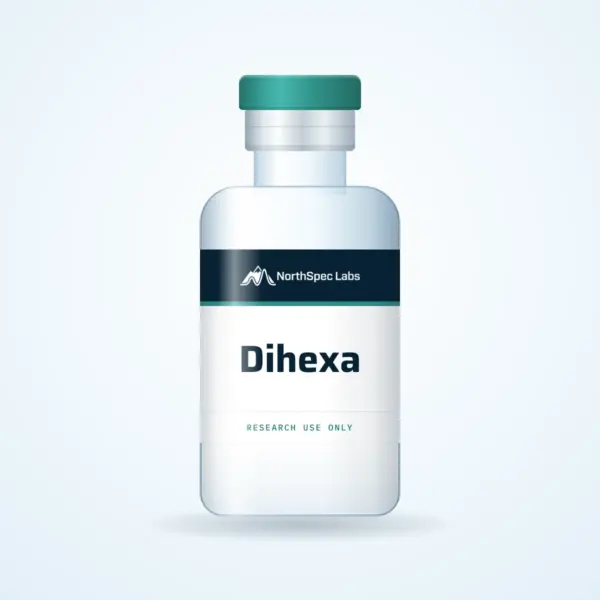
Buy Dihexa 10 mg in Canada
NorthSpecLabs sells Dihexa in Canada in 10 mg vials, for laboratory research use only. The main points are in the table, and each one links to the detail further down the page.
| What it is | Synthetic angiotensin IV analogue |
|---|---|
| Research on this page | 5 topics, 7 references |
| Size | 10 mg |
| Purity and lab report | [TO CONFIRM: from the supplier] Details |
| Delivery | Canada Post, usually 2 to 10 business days, from our Canadian facility. Free shipping from $250. Storage, handling and shipping |
| Tool | Peptide calculator |
What is Dihexa?
Dihexa is an analogue of angiotensin IV (Ang IV), a short peptide that occurs naturally in the body[1]. A 2015 review of small-molecule angiotensin IV analogues described dihexa as a recently synthesized molecule[2]. PubChem gives its chemical name as N-(1-Oxohexyl)-L-tyrosyl-N-(6-amino-6-oxohexyl)-L-isoleucinamide, lists its sequence as YI, and also lists the names PNB-0408 and ATH-1001[3].
All of the research cited on this page is preclinical, meaning it was done in animals or in cultured cells. No study in people is cited.
How Dihexa works
A 2015 review of small-molecule angiotensin IV analogues proposed that dihexa works by augmenting synaptic connectivity through the formation of new functional synapses[2]. The same review noted controversy over the identity of the AT4 receptor protein linked to angiotensin IV[2].
Dihexa research applications
All of the studies cited on this page were done in mice, rats or cultured cells. No study in people is cited.
APP/PS1 mice
In a 2021 study in APP/PS1 mice, a model the authors discuss in the context of Alzheimer's disease, dihexa restored spatial learning and cognitive functions in the Morris water maze test[1]. The authors also reported that dihexa decreased the activation of astrocytes and microglia, reduced levels of the pro-inflammatory cytokines IL-1β and TNF-α, and activated the PI3K/AKT signalling pathway[1].
Review of angiotensin IV analogues
A 2015 review described small-molecule angiotensin IV analogues that were metabolically stable and penetrated the blood-brain barrier[2].
Nerve repair in rats
A 2021 study used a rat model of sciatic nerve transection and repair, with 10 groups of 6 to 8 male Lewis rats followed for 16 weeks[4]. Sensory function returned to nearly normal by 8 weeks in all groups combined[4]. Motor function, scored by walking foot print grades, improved significantly (P < 0.05) at 8 to 16 weeks with mesenchymal stem cells plus dihexa, and with stem cells plus G-CSF, given into the gastrocnemius muscle[4].
No protection in a rat model
In a 2024 study, forty male Wistar rats were given 3-nitropropionic acid (3-NP), a mitochondrial toxin used to mimic Huntington's disease-like symptoms[5]. 3-NP reduced weight gain, impaired spatial learning and memory consolidation and led to marked motor dysfunction, and PNB-0408 (dihexa) did not protect the rats from these deficits over five weeks[5]. The authors concluded that it may not be an efficacious treatment strategy in this preclinical model[5].
Use in cell culture
A 2016 laboratory protocol for turning human pluripotent stem cells into hepatocyte-like (liver-like) cells in vitro used dihexa and dexamethasone at the stage where hepatoblast-like cells are differentiated further[6].
Open a topic to read what the studies reported. A number in square brackets points to a source in the reference list at the end of the page.
Dihexa purity and certificate of analysis
A certificate of analysis (COA) is the lab report for one batch. It lists the tests done on that batch and their results.
[TO CONFIRM: purity, test method and batch certificate of analysis for this product, from the supplier. Once confirmed, this section shows the batch number and a link to the lab report.]
See also the lab reports (COA) page.
Why buy Dihexa from NorthSpecLabs
- Every research statement on this page is tied to a published source, listed under References.
- The page says whether a study was done in cells, in animals or in people.
- Orders ship from our Canadian facility to every province and territory, with free shipping from $250.
[TO CONFIRM: third-party testing and a lab report for every batch. These points are added here once they are confirmed.]
Related: Cognitive peptides, lab supplies and the Learn pages.
Storage, handling and shipping
Storage conditions for each batch are stated on the vial label and on its certificate of analysis. [TO CONFIRM: storage statement from the supplier.]
As general guidance for dry (lyophilized) peptides, the peptide manufacturer Bachem recommends storing them in tightly closed containers below −15 °C, and letting a cold container reach room temperature in a desiccator before it is opened. Bachem also notes that long-term storage of peptide solutions is not recommended[7].
To work out the concentration of a solution, use the peptide calculator. It does the arithmetic only.
Orders ship from our Canadian facility to every province and territory, in an insulated box with gel ice packs. They leave 1 to 2 business days after payment arrives, and Canada Post usually takes 2 to 10 business days. Every order gets a tracking number by email. See also Shipping and returns.
Regulatory status
NorthSpecLabs sells Dihexa for laboratory research use only. This product has not been reviewed or authorized by Health Canada for use in humans or animals.
Questions and answers
What is dihexa?
Dihexa is a synthetic analogue of angiotensin IV, a peptide that occurs naturally in the body. The studies cited on this page used mice, rats and cultured cells.
Is dihexa approved for human use?
No. NorthSpecLabs sells dihexa for laboratory research use only, and this product has not been reviewed or authorized by Health Canada for use in humans or animals.
What has dihexa research studied?
Animal studies have looked at spatial learning in a mouse model, limb function after nerve repair in rats, and Huntington's disease-like symptoms in rats, where PNB-0408 (dihexa) did not protect against the deficits. It has also been used in a stem cell laboratory protocol. No study in people is cited on this page.
What is the sequence and molecular weight of dihexa?
PubChem lists the sequence as YI. The molecular formula is C27H44N4O5 and the molecular weight is 504.7 g/mol (PubChem CID 129010512).
What sizes of dihexa does NorthSpecLabs carry?
10 mg vials.
Does NorthSpecLabs provide dosing or usage instructions?
No. Products are sold for laboratory research use only. NorthSpecLabs does not provide dosing, administration or medical advice.
Compound details
Names, type and molecular data
| Compound | Dihexa |
|---|---|
| Also known as | PNB-0408, ATH-1001, TS-09667, T7376, N-hexanoic-Tyr-Ile-(6) aminohexanoic amide, Hexanoyl-Tyr-Ile-Ahx-NH2 |
| Type | Synthetic angiotensin IV analogue |
| Sequence | YI |
| Molecular formula | C27H44N4O5 |
| Molecular weight | 504.7 g/mol |
| CAS number | 1401708-83-5 |
| PubChem CID | 129010512 |
| Sizes | 10 mg |
Molecular data are from PubChem. Follow the CID link to check them.
References
- Sun X, Deng Y, Fu X, et al. AngIV-Analog Dihexa Rescues Cognitive Impairment and Recovers Memory in the APP/PS1 Mouse via the PI3K/AKT Signaling Pathway. Brain Sci. 2021;11(11). PubMed 34827486
- Wright JW, Kawas LH, Harding JW. The development of small molecule angiotensin IV analogs to treat Alzheimer's and Parkinson's diseases. Prog Neurobiol. 2015;125:26-46. PubMed 25455861
- PubChem. N-(1-Oxohexyl)-L-tyrosyl-N-(6-amino-6-oxohexyl)-L-isoleucinamide, compound summary for CID 129010512. National Center for Biotechnology Information. Open source
- Weiss JB, Phillips CJ, Malin EW, et al. Stem cell, Granulocyte-Colony Stimulating Factor and/or Dihexa to promote limb function recovery in a rat sciatic nerve damage-repair model: Experimental animal studies. Ann Med Surg (Lond). 2021;71:102917. PubMed 34703584
- Wells RG, Azzam AF, Hiller AL, et al. Effects of an Angiotensin IV Analog on 3-Nitropropionic Acid-Induced Huntington's Disease-Like Symptoms in Rats. J Huntingtons Dis. 2024;13(1):55-66. PubMed 38489193
- Mathapati S, Siller R, Impellizzeri AA, et al. Small-Molecule-Directed Hepatocyte-Like Cell Differentiation of Human Pluripotent Stem Cells. Curr Protoc Stem Cell Biol. 2016;38:1G.6.1-1G.6.18. PubMed 27532814
- Bachem. Handling and Storage Guidelines for Peptides. Bachem Knowledge Center. Open source
Last reviewed: October 3, 2026. This page summarises published research. It is not medical advice.
Reviews
There are no reviews yet.