
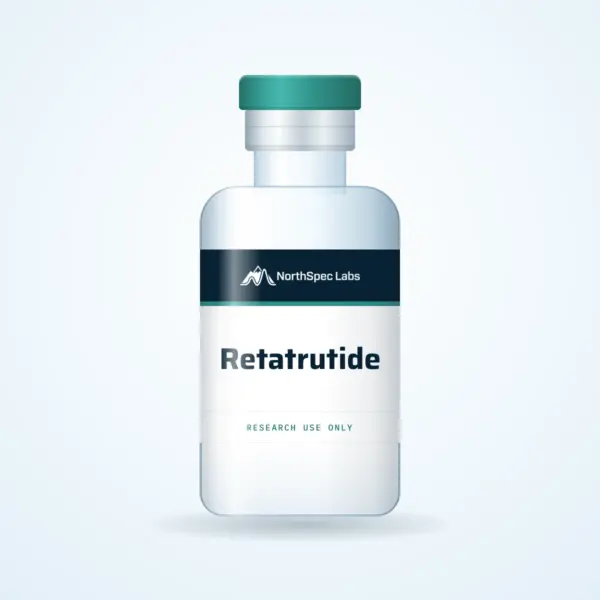
Buy Retatrutide 10 mg in Canada
NorthSpecLabs sells Retatrutide in Canada in 10 mg vials, for laboratory research use only. The main points are in the table, and each one links to the detail further down the page.
| What it is | Peptide agonist of the GIP, GLP-1 and glucagon receptors |
|---|---|
| Research on this page | 6 topics, 7 references |
| Size | 10 mg |
| Purity and lab report | [TO CONFIRM: from the supplier] Details |
| Delivery | Canada Post, usually 2 to 10 business days, from our Canadian facility. Free shipping from $250. Storage, handling and shipping |
| Tool | Peptide calculator |
What is Retatrutide?
Retatrutide, also written LY3437943, is a single peptide with activity at three hormone receptors[1][2].
Retatrutide has been tested in obese mice and, in people, in a phase 1 study and in phase 2 and phase 3 trials. The phase 2 trial in type 2 diabetes reported that its data informed dose selection for the phase 3 program, and named Eli Lilly and Company as its funder[2].
How Retatrutide works
Retatrutide is an agonist (an activator) of all three: the glucose-dependent insulinotropic polypeptide (GIP) receptor, the glucagon-like peptide 1 (GLP-1) receptor and the glucagon receptor[1]. In laboratory tests, it showed balanced activity at the glucagon and GLP-1 receptors and more activity at the GIP receptor[3]. In obese mice, a 2022 paper reported that the weight loss combined a lower calorie intake, driven by the GIP and GLP-1 receptors, with a rise in energy expenditure driven by the glucagon receptor[3].
Retatrutide research applications
Published research on retatrutide includes a study in obese mice, a phase 1 study, and phase 2 and phase 3 trials in adults with obesity or type 2 diabetes. Each trial report also lists the adverse events (unwanted effects) that were recorded.
Early studies: laboratory tests, mice and a first study in people
A 2022 paper described LY3437943, the code name used for retatrutide, as a new peptide that activates the glucagon, GIP and GLP-1 receptors[3]. In obese mice it decreased body weight and improved glycemic control (the control of blood sugar)[3]. In a phase 1 study of single doses, the authors reported a safety and tolerability profile similar to other incretins (medicines based on gut hormones), and a reduction in body weight that persisted up to day 43 after one dose[3].
Phase 2 trial in adults with obesity
A phase 2, double-blind, randomized, placebo-controlled trial enrolled 338 adults with a body-mass index (BMI) of 30 or higher, or of 27 to less than 30 plus at least one weight-related condition[1]. Participants received retatrutide at one of several dose levels, or placebo, for 48 weeks, and the main measure was the percentage change in body weight after 24 weeks[1]. At 24 weeks, average body weight had fallen by 7.2% in the lowest dose group and by 17.5% in the highest, compared with 1.6% with placebo[1]. At 48 weeks, the average fall was 24.2% in the highest dose group and 2.1% with placebo[1]. The most common adverse events were gastrointestinal (affecting the stomach and gut), were dose-related and were mostly mild to moderate in severity[1]. Dose-dependent increases in heart rate peaked at 24 weeks and declined afterwards[1].
Liver fat substudy
A substudy of that trial followed 98 participants who had metabolic dysfunction-associated steatotic liver disease (a form of fatty liver disease) and liver fat of 10% or more[4]. At 24 weeks, liver fat had fallen by an average of 42.9% of its starting level in the lowest dose group and by 82.4% in the highest, while it rose by 0.3% with placebo[4]. The authors reported that the reductions in liver fat were significantly related to changes in body weight and abdominal fat[4].
Phase 2 trial in adults with type 2 diabetes
A phase 2 trial at 42 centres in the USA randomly assigned 281 adults with type 2 diabetes to retatrutide, to placebo or to dulaglutide, a comparison medicine[2]. The main measure was the change in HbA1c (glycated hemoglobin, a measure of average blood sugar) at 24 weeks: it fell by 2.02 percentage points in the highest dose group, by 0.01 with placebo and by 1.41 with dulaglutide[2]. Body weight at 36 weeks had fallen in a dose-dependent way, by 16.94% in the highest dose group compared with 3.00% with placebo[2]. Mild-to-moderate gastrointestinal adverse events, including nausea, diarrhea, vomiting and constipation, were reported by 35% of participants in the retatrutide groups and 13% in the placebo group[2]. There were no reports of severe hypoglycemia (very low blood sugar) and no deaths during the study[2].
Phase 3 trial in type 2 diabetes (TRANSCEND-T2D-1)
TRANSCEND-T2D-1, published in 2026, was a 40-week phase 3 trial at 48 sites in the USA, Mexico and India[5]. It randomly assigned 537 adults, whose type 2 diabetes was inadequately controlled by diet and exercise alone, to one of three retatrutide dose groups or to placebo[5]. At week 40, HbA1c had fallen by 1.94 percentage points in the highest dose group and by 0.81 with placebo[5]. Body weight had fallen by 15.3% in the highest dose group and by 2.6% with placebo[5]. The most frequent adverse events with retatrutide were generally mild to moderate gastrointestinal events[5]. Between 2% and 5% of participants in the retatrutide groups stopped the study treatment because of adverse events, compared with 0% with placebo, and no severe hypoglycemia was reported[5]. Two deaths occurred during the study, both in the lowest dose group, and were reported as unrelated to the study drug[5].
Phase 3 trial in obesity with type 2 diabetes (TRIUMPH-2)
TRIUMPH-2, published in 2026, was a phase 3 trial across eight countries that randomly assigned 1,152 adults with obesity and type 2 diabetes, with its main measure at week 80[6]. At week 80, body weight had fallen by 18.8% in the highest dose group and by 5.1% with placebo[6]. The most frequently reported adverse events were gastrointestinal: diarrhea occurred in 34% of the highest dose group and 13% of the placebo group, and nausea in 28% and 8%[6]. Low blood pressure (hypotension) and dysesthesia (abnormal sensations) were more frequent with retatrutide than with placebo[6]. More participants in the two higher dose groups than in the lowest dose group or the placebo group stopped treatment permanently because of adverse events or death[6]. Two participants died in the lowest dose group, three in the middle dose group, one in the highest dose group and one in the placebo group; the investigators judged all deaths to be unrelated to the study treatment[6].
Open a topic to read what the studies reported. A number in square brackets points to a source in the reference list at the end of the page.
Retatrutide purity and certificate of analysis
A certificate of analysis (COA) is the lab report for one batch. It lists the tests done on that batch and their results.
[TO CONFIRM: purity, test method and batch certificate of analysis for this product, from the supplier. Once confirmed, this section shows the batch number and a link to the lab report.]
See also the lab reports (COA) page.
Why buy Retatrutide from NorthSpecLabs
- Every research statement on this page is tied to a published source, listed under References.
- The page says whether a study was done in cells, in animals or in people.
- Orders ship from our Canadian facility to every province and territory, with free shipping from $250.
[TO CONFIRM: third-party testing and a lab report for every batch. These points are added here once they are confirmed.]
Related: Metabolic peptides, lab supplies and the Learn pages.
Storage, handling and shipping
Storage conditions for each batch are stated on the vial label and on its certificate of analysis. [TO CONFIRM: storage statement from the supplier.]
As general guidance for dry (lyophilized) peptides, the peptide manufacturer Bachem recommends storing them in tightly closed containers below −15 °C, and letting a cold container reach room temperature in a desiccator before it is opened. Bachem also notes that long-term storage of peptide solutions is not recommended[7].
To work out the concentration of a solution, use the peptide calculator. It does the arithmetic only.
Orders ship from our Canadian facility to every province and territory, in an insulated box with gel ice packs. They leave 1 to 2 business days after payment arrives, and Canada Post usually takes 2 to 10 business days. Every order gets a tracking number by email. See also Shipping and returns.
Regulatory status
NorthSpecLabs sells Retatrutide for laboratory research use only. This product has not been reviewed or authorized by Health Canada for use in humans or animals.
A trial report published in 2026 describes retatrutide as under clinical development for type 2 diabetes, obesity and related complications[5]. A second 2026 report describes it as currently under investigation for the treatment of obesity, type 2 diabetes and other conditions, including knee osteoarthritis and obstructive sleep apnea[6].
Questions and answers
What is retatrutide?
Retatrutide (LY3437943) is a single peptide that activates three hormone receptors: GIP, GLP-1 and glucagon. Its name is often shortened to reta.
Is retatrutide approved for human use?
No. NorthSpecLabs sells retatrutide for laboratory research use only, and this product has not been reviewed or authorized by Health Canada for use in humans or animals. A trial report published in 2026 describes retatrutide as under clinical development.
Is retatrutide available in Canada?
NorthSpecLabs supplies retatrutide in Canada for laboratory research use only. This product has not been reviewed or authorized by Health Canada for use in humans or animals.
How does retatrutide work?
Retatrutide activates three hormone receptors: the GIP, GLP-1 and glucagon receptors. In obese mice, the authors of a 2022 paper reported that weight loss combined a lower calorie intake, driven by the GIP and GLP-1 receptors, with a rise in energy expenditure driven by the glucagon receptor.
What has retatrutide research studied?
Body weight, blood sugar control and liver fat. It has been tested in obese mice, in a phase 1 study, in phase 2 trials in adults with obesity or type 2 diabetes, and in two phase 3 trials published in 2026.
What side effects were reported in retatrutide trials?
The trials most often reported gastrointestinal adverse events such as nausea and diarrhea, mostly mild to moderate. A phase 2 trial also reported dose-dependent increases in heart rate, and a phase 3 trial reported low blood pressure and dysesthesia more often with retatrutide than with placebo.
What sizes of retatrutide does NorthSpecLabs carry?
10 mg vials.
Does NorthSpecLabs provide dosing or usage instructions?
No. Products are sold for laboratory research use only. NorthSpecLabs does not provide dosing, administration or medical advice.
Compound details
Names, type and molecular data
| Compound | Retatrutide |
|---|---|
| Also known as | LY3437943 |
| Type | Peptide, agonist of the GIP, GLP-1 and glucagon receptors |
| Molecular data | [TO CONFIRM: from the supplier’s certificate of analysis] |
| Sizes | 10 mg |
References
- Jastreboff AM, Kaplan LM, Frías JP, et al. Triple-Hormone-Receptor Agonist Retatrutide for Obesity – A Phase 2 Trial. N Engl J Med. 2023;389(6):514-526. PubMed 37366315
- Rosenstock J, Frias J, Jastreboff AM, et al. Retatrutide, a GIP, GLP-1 and glucagon receptor agonist, for people with type 2 diabetes: a randomised, double-blind, placebo and active-controlled, parallel-group, phase 2 trial conducted in the USA. Lancet. 2023;402(10401):529-544. PubMed 37385280
- Coskun T, Urva S, Roell WC, et al. LY3437943, a novel triple glucagon, GIP, and GLP-1 receptor agonist for glycemic control and weight loss: From discovery to clinical proof of concept. Cell Metab. 2022;34(9):1234-1247.e9. PubMed 35985340
- Sanyal AJ, Kaplan LM, Frias JP, et al. Triple hormone receptor agonist retatrutide for metabolic dysfunction-associated steatotic liver disease: a randomized phase 2a trial. Nat Med. 2024;30(7):2037-2048. PubMed 38858523
- Bajaj HS, Welch M, Shah P, et al. Efficacy and safety of retatrutide, a GIP, GLP-1, and glucagon receptor agonist, in people with type 2 diabetes and inadequate glycaemic control with diet and exercise (TRANSCEND-T2D-1): a double-blind, randomised, phase 3 trial. Lancet. 2026;407(10546):2402-2413. PubMed 42250575
- Bellido V, le Roux CW, Ekinci EI, et al. Retatrutide in adults with obesity and type 2 diabetes (TRIUMPH-2): a double-blind, parallel-group, randomised, placebo-controlled, phase 3 trial. Lancet. 2026. PubMed 42810372
- Bachem. Handling and Storage Guidelines for Peptides. Bachem Knowledge Center. Open source
Last reviewed: October 6, 2026. This page summarises published research. It is not medical advice.
Reviews
There are no reviews yet.