
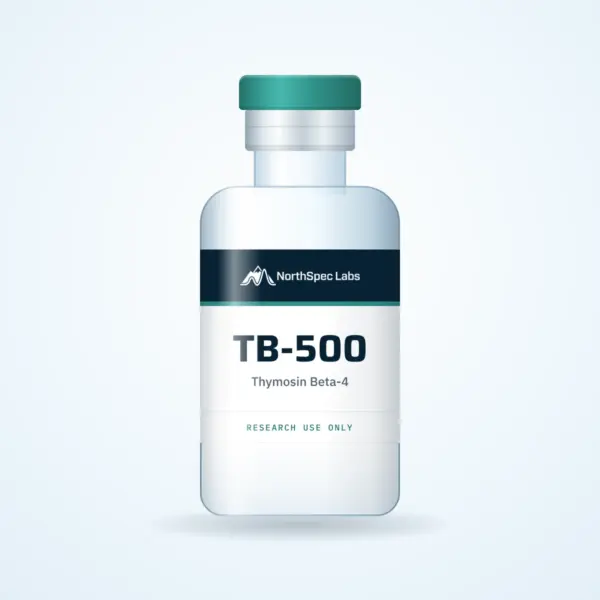
Buy TB-500 (Thymosin Beta-4) in Canada
NorthSpecLabs sells TB-500 (Thymosin Beta-4) in Canada in 5 mg, 10 mg and 20 mg vials, for laboratory research use only. The main points are in the table, and each one links to the detail further down the page.
| What it is | Synthetic peptide based on thymosin beta-4 |
|---|---|
| Research on this page | 5 topics, 7 references |
| Sizes | 5 mg, 10 mg, 20 mg |
| Purity and lab report | [TO CONFIRM: from the supplier] Details |
| Delivery | Canada Post, usually 2 to 10 business days, from our Canadian facility. Free shipping from $250. Storage, handling and shipping |
| Tool | Peptide calculator |
What is TB-500 (Thymosin Beta-4)?
Thymosin beta-4 is a naturally occurring peptide of 43 amino acids[1].
The name TB-500 comes from a veterinary product. Doping-control chemists who analyzed that product reported that its key ingredient was a synthetic, N-acetylated version of the 7-amino-acid segment LKKTETQ (positions 17 to 23 of thymosin beta-4), which they describe as the site responsible for actin binding, cell migration and wound healing[2]. Many suppliers label TB-500 as thymosin beta-4 itself.
How TB-500 (Thymosin Beta-4) works
A 2012 review states that thymosin beta-4 binds actin, a protein of the cell skeleton, and promotes cell migration, including the mobilization, migration and differentiation of stem and progenitor cells, which form new blood vessels and regenerate tissue[3]. The treatment studies cited on this page used thymosin beta-4 itself or a formulation of it, not the short segment found in the TB-500 veterinary product.
TB-500 (Thymosin Beta-4) research applications
The research below is on thymosin beta-4. Most of it is in animals, with some early clinical trials of pharmaceutical formulations.
Wound models
In a rat full-thickness wound model, thymosin beta-4 applied to the wound or injected into the abdomen increased re-epithelialization by 42% at 4 days and by as much as 61% at 7 days compared with saline controls. Treated wounds also showed more collagen deposition and angiogenesis[4].
Heart models
In mice, thymosin beta-4 treatment after coronary artery ligation enhanced early survival of heart muscle cells and improved cardiac function. The authors linked this to higher activity of integrin-linked kinase and the survival kinase Akt[5].
Review
A 2012 review describes thymosin beta-4 as being released by platelets, macrophages and many other cell types after injury, and discusses its potential in the repair of skin, eye, heart and brain tissue[3].
Clinical trials of pharmaceutical formulations
A phase 2 trial of a 0.1% thymosin beta-4 eye drop (RGN-259) in 72 people with dry eye found no significant difference from placebo on either primary endpoint, although several secondary endpoints differed significantly[6].
Doping control
TB-500 is monitored in equine sport. A 2012 paper described a method to detect N-acetylated LKKTETQ and its metabolites in horse urine and plasma[2].
Open a topic to read what the studies reported. A number in square brackets points to a source in the reference list at the end of the page.
TB-500 (Thymosin Beta-4) purity and certificate of analysis
A certificate of analysis (COA) is the lab report for one batch. It lists the tests done on that batch and their results.
[TO CONFIRM: purity, test method and batch certificate of analysis for this product, from the supplier. Once confirmed, this section shows the batch number and a link to the lab report.]
See also the lab reports (COA) page.
Why buy TB-500 (Thymosin Beta-4) from NorthSpecLabs
- Every research statement on this page is tied to a published source, listed under References.
- The page says whether a study was done in cells, in animals or in people.
- Orders ship from our Canadian facility to every province and territory, with free shipping from $250.
[TO CONFIRM: third-party testing and a lab report for every batch. These points are added here once they are confirmed.]
Related: Recovery peptides, lab supplies and the Learn pages.
Storage, handling and shipping
Storage conditions for each batch are stated on the vial label and on its certificate of analysis. [TO CONFIRM: storage statement from the supplier.]
As general guidance for dry (lyophilized) peptides, the peptide manufacturer Bachem recommends storing them in tightly closed containers below −15 °C, and letting a cold container reach room temperature in a desiccator before it is opened. Bachem also notes that long-term storage of peptide solutions is not recommended[7].
To work out the concentration of a solution, use the peptide calculator. It does the arithmetic only.
Orders ship from our Canadian facility to every province and territory, in an insulated box with gel ice packs. They leave 1 to 2 business days after payment arrives, and Canada Post usually takes 2 to 10 business days. Every order gets a tracking number by email. See also Shipping and returns.
Regulatory status
NorthSpecLabs sells TB-500 (Thymosin Beta-4) for laboratory research use only. This product has not been reviewed or authorized by Health Canada for use in humans or animals.
Questions and answers
What is TB-500?
TB-500 is a synthetic peptide based on thymosin beta-4, a naturally occurring 43-amino-acid peptide that binds actin and promotes cell migration.
Is TB-500 the same as thymosin beta-4?
Not always. The veterinary product called TB-500 was reported to contain N-acetylated LKKTETQ, a 7-amino-acid segment of thymosin beta-4. Many suppliers use the name for the full 43-amino-acid peptide. The certificate of analysis shows which one a batch contains.
Is TB-500 approved for human use?
No. NorthSpecLabs sells TB-500 for laboratory research use only, and this product has not been reviewed or authorized by Health Canada for use in humans or animals.
What has thymosin beta-4 research studied?
Wound healing in rats, heart repair in mice, and early clinical trials of pharmaceutical formulations such as an eye drop for dry eye.
What sizes of TB-500 does NorthSpecLabs carry?
5 mg, 10 mg and 20 mg vials.
Does NorthSpecLabs provide dosing or usage instructions?
No. Products are sold for laboratory research use only. NorthSpecLabs does not provide dosing, administration or medical advice.
Compound details
Names, type and molecular data
| Compound | TB-500 |
|---|---|
| Based on | Thymosin beta-4 (also listed as timbetasin) |
| Thymosin beta-4 sequence | Ac-SDKPDMAEIEKFDKSKLKKTETQEKNPLPSKETIEQEKQAGES (43 amino acids) |
| Thymosin beta-4 formula | C212H350N56O78S |
| Thymosin beta-4 molecular weight | 4963 g/mol |
| Thymosin beta-4 CAS number | 77591-33-4 |
| PubChem CID (thymosin beta-4) | 16132341 |
| Fragment reported in TB-500 | N-acetyl-LKKTETQ (thymosin beta-4 positions 17 to 23) |
| Contents of our vials | [TO CONFIRM: full-length thymosin beta-4 or the N-acetyl-LKKTETQ fragment, from the supplier’s certificate of analysis] |
| Sizes | 5 mg, 10 mg, 20 mg |
Molecular data are from PubChem. Follow the CID link to check them.
References
- UniProt. P62328, Thymosin beta-4 (human). UniProt Knowledgebase. Open source
- Ho EN, Kwok WH, Lau MY, et al. Doping control analysis of TB-500, a synthetic version of an active region of thymosin β₄, in equine urine and plasma by liquid chromatography-mass spectrometry. J Chromatogr A. 2012;1265:57-69. PubMed 23084823
- Goldstein AL, Hannappel E, Sosne G, et al. Thymosin β4: a multi-functional regenerative peptide. Basic properties and clinical applications. Expert Opin Biol Ther. 2012;12(1):37-51. PubMed 22074294
- Malinda KM, Sidhu GS, Mani H, et al. Thymosin beta4 accelerates wound healing. J Invest Dermatol. 1999;113(3):364-8. PubMed 10469335
- Bock-Marquette I, Saxena A, White MD, et al. Thymosin beta4 activates integrin-linked kinase and promotes cardiac cell migration, survival and cardiac repair. Nature. 2004;432(7016):466-72. PubMed 15565145
- Sosne G, Ousler GW. Thymosin beta 4 ophthalmic solution for dry eye: a randomized, placebo-controlled, Phase II clinical trial conducted using the controlled adverse environment (CAE™) model. Clin Ophthalmol. 2015;9:877-84. PubMed 26056426
- Bachem. Handling and Storage Guidelines for Peptides. Bachem Knowledge Center. Open source
Last reviewed: October 3, 2026. This page summarises published research. It is not medical advice.
Reviews
There are no reviews yet.