
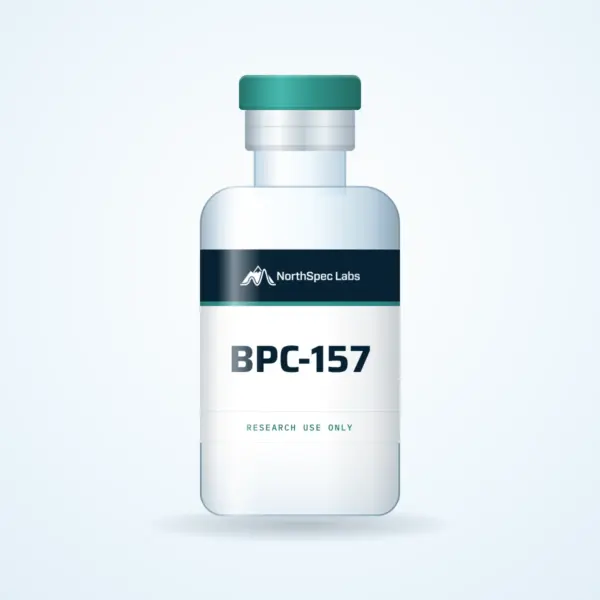
Buy BPC-157 in Canada
NorthSpecLabs sells BPC-157 in Canada in 10 mg and 20 mg vials, for laboratory research use only. The main points are in the table, and each one links to the detail further down the page.
| What it is | Synthetic peptide of 15 amino acids |
|---|---|
| Research on this page | 3 topics, 7 references |
| Sizes | 10 mg, 20 mg |
| Purity and lab report | [TO CONFIRM: from the supplier] Details |
| Delivery | Canada Post, usually 2 to 10 business days, from our Canadian facility. Free shipping from $250. Storage, handling and shipping |
| Tool | Peptide calculator |
What is BPC-157?
BPC-157 is a synthetic peptide made of 15 amino acids, with the sequence Gly-Glu-Pro-Pro-Pro-Gly-Lys-Pro-Ala-Asp-Asp-Ala-Gly-Leu-Val[1]. The name is short for Body Protection Compound-157. In the research literature it is often called the “stable gastric pentadecapeptide BPC 157”[2].
Almost all published work on BPC-157 is preclinical, meaning cell and animal studies. A 2019 review noted that most studies had used small rodent models, that only a handful of research groups had studied the peptide in depth, and that its efficacy had not yet been confirmed in humans[3].
How BPC-157 works
The mechanisms described on this page come from preclinical studies, meaning cell and animal work. A 2025 systematic review summarizes preclinical findings that BPC-157 increases growth hormone receptor expression and activates several pathways involved in cell growth and the formation of new blood vessels (angiogenesis), while lowering inflammatory cytokines[4].
BPC-157 research applications
Published research on BPC-157 is mostly in rodents. Human evidence is very limited.
Tendon, ligament and muscle models
A 2019 review of tendon, ligament and skeletal-muscle studies reported consistently positive healing results across the animal injury models it covered[3]. A 2025 systematic review in orthopaedic sports medicine identified 544 articles published from 1993 to 2024 and included 36 studies: 35 preclinical and one clinical[4].
Skin wound models
A 2021 review by Seiwerth and colleagues covers rat models of skin wounds, deep burns, diabetic ulcers and alkali burns[2].
Human data
Published human data are very limited. They include a retrospective chart review of 17 patients who had received knee injections, followed up by phone survey[5], and a pilot study in 12 women with interstitial cystitis[6]. A PubMed search on October 3, 2026 found no BPC-157 publication indexed as a randomized controlled trial.
Open a topic to read what the studies reported. A number in square brackets points to a source in the reference list at the end of the page.
BPC-157 purity and certificate of analysis
A certificate of analysis (COA) is the lab report for one batch. It lists the tests done on that batch and their results.
[TO CONFIRM: purity, test method and batch certificate of analysis for this product, from the supplier. Once confirmed, this section shows the batch number and a link to the lab report.]
See also the lab reports (COA) page.
Why buy BPC-157 from NorthSpecLabs
- Every research statement on this page is tied to a published source, listed under References.
- The page says whether a study was done in cells, in animals or in people.
- Orders ship from our Canadian facility to every province and territory, with free shipping from $250.
[TO CONFIRM: third-party testing and a lab report for every batch. These points are added here once they are confirmed.]
Related: Recovery peptides, lab supplies and the Learn pages.
Storage, handling and shipping
Storage conditions for each batch are stated on the vial label and on its certificate of analysis. [TO CONFIRM: storage statement from the supplier.]
As general guidance for dry (lyophilized) peptides, the peptide manufacturer Bachem recommends storing them in tightly closed containers below −15 °C, and letting a cold container reach room temperature in a desiccator before it is opened. Bachem also notes that long-term storage of peptide solutions is not recommended[7].
To work out the concentration of a solution, use the peptide calculator. It does the arithmetic only.
Orders ship from our Canadian facility to every province and territory, in an insulated box with gel ice packs. They leave 1 to 2 business days after payment arrives, and Canada Post usually takes 2 to 10 business days. Every order gets a tracking number by email. See also Shipping and returns.
Regulatory status
NorthSpecLabs sells BPC-157 for laboratory research use only. This product has not been reviewed or authorized by Health Canada for use in humans or animals.
A 2025 systematic review notes that BPC-157 lacks US Food and Drug Administration approval and that its use is banned in professional sports[4].
Questions and answers
What is BPC-157?
BPC-157 is a synthetic peptide of 15 amino acids, also called Body Protection Compound-157. It has been studied mainly in animal models of tissue healing.
Is BPC-157 approved for human use?
No. NorthSpecLabs sells BPC-157 for laboratory research use only, and this product has not been reviewed or authorized by Health Canada for use in humans or animals. A 2025 systematic review also notes that it lacks US FDA approval.
What has BPC-157 research studied?
Mostly the healing of tendon, ligament, muscle and skin in rodent models. A 2025 systematic review included 35 preclinical studies and one clinical study. Its effects in humans have not been confirmed.
What is the sequence and molecular weight of BPC-157?
The sequence is Gly-Glu-Pro-Pro-Pro-Gly-Lys-Pro-Ala-Asp-Asp-Ala-Gly-Leu-Val. The molecular formula is C62H98N16O22 and the molecular weight is 1419.5 g/mol (PubChem CID 9941957).
What sizes of BPC-157 does NorthSpecLabs carry?
10 mg and 20 mg vials.
Does NorthSpecLabs provide dosing or usage instructions?
No. Products are sold for laboratory research use only. NorthSpecLabs does not provide dosing, administration or medical advice.
Compound details
Names, type and molecular data
| Compound | BPC-157 |
|---|---|
| Also known as | Body Protection Compound-157, BPC 157, Bepecin, PL-10, PLD-116 |
| Type | Synthetic peptide, 15 amino acids |
| Sequence | Gly-Glu-Pro-Pro-Pro-Gly-Lys-Pro-Ala-Asp-Asp-Ala-Gly-Leu-Val (GEPPPGKPADDAGLV) |
| Molecular formula | C62H98N16O22 |
| Molecular weight | 1419.5 g/mol |
| CAS number | 137525-51-0 |
| PubChem CID | 9941957 |
| Sizes | 10 mg, 20 mg |
Molecular data are from PubChem. Follow the CID link to check them.
References
- PubChem. BPC-157, compound summary for CID 9941957. National Center for Biotechnology Information. Open source
- Seiwerth S, Milavic M, Vukojevic J, et al. Stable Gastric Pentadecapeptide BPC 157 and Wound Healing. Front Pharmacol. 2021;12:627533. PubMed 34267654
- Gwyer D, Wragg NM, Wilson SL. Gastric pentadecapeptide body protection compound BPC 157 and its role in accelerating musculoskeletal soft tissue healing. Cell Tissue Res. 2019;377(2):153-159. PubMed 30915550
- Vasireddi N, Hahamyan H, Salata MJ, et al. Emerging Use of BPC-157 in Orthopaedic Sports Medicine: A Systematic Review. HSS J. 2025;21(4):485-495. PubMed 40756949
- Lee E, Padgett B. Intra-Articular Injection of BPC 157 for Multiple Types of Knee Pain. Altern Ther Health Med. 2021;27(4):8-13. PubMed 34324435
- Lee E, Walker C, Ayadi B. Effect of BPC-157 on Symptoms in Patients with Interstitial Cystitis: A Pilot Study. Altern Ther Health Med. 2024;30(10):12-17. PubMed 39325560
- Bachem. Handling and Storage Guidelines for Peptides. Bachem Knowledge Center. Open source
Last reviewed: October 3, 2026. This page summarises published research. It is not medical advice.
Reviews
There are no reviews yet.