
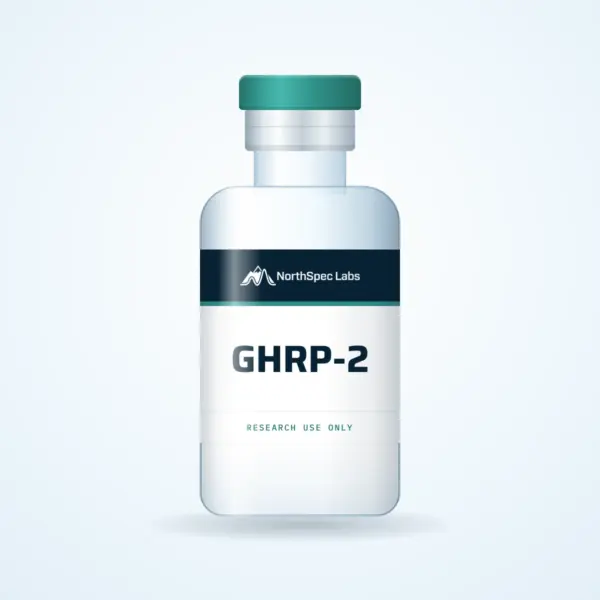
Buy GHRP-2 5 mg in Canada
NorthSpecLabs sells GHRP-2 in Canada in 5 mg vials, for laboratory research use only. The main points are in the table, and each one links to the detail further down the page.
| What it is | Synthetic hexapeptide, growth hormone secretagogue |
|---|---|
| Research on this page | 5 topics, 8 references |
| Size | 5 mg |
| Purity and lab report | [TO CONFIRM: from the supplier] Details |
| Delivery | Canada Post, usually 2 to 10 business days, from our Canadian facility. Free shipping from $250. Storage, handling and shipping |
| Tool | Peptide calculator |
What is GHRP-2?
GHRP-2 (growth hormone-releasing peptide-2), also called pralmorelin and KP-102, is a synthetic growth hormone (GH) secretagogue, a compound that triggers GH release[1]. It consists of six amino acid residues[2]. PubChem gives the sequence as H-D-Ala-D-2Nal-Ala-Trp-D-Phe-Lys-NH2[3].
A 2004 drug profile says pralmorelin came from a series of compounds developed by Polygen in Germany and Tulane University in the US[4].
How GHRP-2 works
The same profile states that the peptides of this series mimic the actions of ghrelin, a 28 amino acid peptide that regulates the release of GH[4].
GHRP-2 research applications
Research on GHRP-2 includes cell studies, animal studies in rats and dogs, and studies in healthy human volunteers in which it was used as a test stimulus.
Pituitary cells
In a 1994 study of cultured sheep pituitary cells, GHRP-2 (then newly synthesized and also named KP 102) caused a dose-dependent increase in GH secretion[5]. It had similar potency to GRF (GH-releasing factor) and was 10-fold more potent than the earlier peptides GHRP-6 and GHRP-1 tested in the same system[5]. When GRF and GHRP-2 were given together, their effects on GH release added up[5].
Rats and dogs
In conscious rats, the GH-releasing activity of GHRP-2 was more potent than that of administered GH-releasing hormone (GHRH), and GHRP-2 also released GH in conscious dogs, where GHRH did not raise serum GH levels[1]. In conscious rats it stimulated the secretion of adrenocorticotrophic hormone (ACTH) and corticosterone, but not of prolactin[1]. Three weeks of administration produced a growth-accelerating effect and a slight increase in body weight in rats[1].
How the body handled it in rats
In a study of 24 rats, plasma concentrations of pralmorelin fell rapidly after a single intravenous dose, and 80% of the dose was recovered unchanged in the bile within 1 hour[2].
Studies in healthy volunteers
The two studies described here used GHRP-2 as a test stimulus to examine how GH secretion is controlled. They were not trials of GHRP-2 as a treatment. In 17 healthy men aged 19 to 71, GHRP-2, described there as a ghrelin analogue, was given after a pulse of GH to overcome negative feedback (GH damping its own release), and increased age predicted impaired GH feedback[6]. In 25 healthy men and women, GHRP-2 and GHRH were used as continuous stimuli during an experimental GH feedback clamp[7].
Diagnostic use studied
The 2004 drug profile describes the use of pralmorelin as a diagnostic agent for GH deficiency, based on its ability to markedly increase plasma GH levels in healthy subjects, with a significantly lower effect in patients with GH deficiency[4].
Open a topic to read what the studies reported. A number in square brackets points to a source in the reference list at the end of the page.
GHRP-2 purity and certificate of analysis
A certificate of analysis (COA) is the lab report for one batch. It lists the tests done on that batch and their results.
[TO CONFIRM: purity, test method and batch certificate of analysis for this product, from the supplier. Once confirmed, this section shows the batch number and a link to the lab report.]
See also the lab reports (COA) page.
Why buy GHRP-2 from NorthSpecLabs
- Every research statement on this page is tied to a published source, listed under References.
- The page says whether a study was done in cells, in animals or in people.
- Orders ship from our Canadian facility to every province and territory, with free shipping from $250.
[TO CONFIRM: third-party testing and a lab report for every batch. These points are added here once they are confirmed.]
Related: Metabolic peptides, lab supplies and the Learn pages.
Storage, handling and shipping
Storage conditions for each batch are stated on the vial label and on its certificate of analysis. [TO CONFIRM: storage statement from the supplier.]
As general guidance for dry (lyophilized) peptides, the peptide manufacturer Bachem recommends storing them in tightly closed containers below −15 °C, and letting a cold container reach room temperature in a desiccator before it is opened. Bachem also notes that long-term storage of peptide solutions is not recommended[8].
To work out the concentration of a solution, use the peptide calculator. It does the arithmetic only.
Orders ship from our Canadian facility to every province and territory, in an insulated box with gel ice packs. They leave 1 to 2 business days after payment arrives, and Canada Post usually takes 2 to 10 business days. Every order gets a tracking number by email. See also Shipping and returns.
Regulatory status
NorthSpecLabs sells GHRP-2 for laboratory research use only. This product has not been reviewed or authorized by Health Canada for use in humans or animals.
A 2004 drug profile reported that pralmorelin was then awaiting approval in Japan as a diagnostic agent for hypothalamo-pituitary function (the working of the hypothalamus and pituitary gland)[4]. The same profile reported that it had been in phase II trials in the US for the treatment of GH deficiency, and that its development there appeared to have been discontinued[4].
Questions and answers
What is GHRP-2?
GHRP-2 (growth hormone-releasing peptide-2), also called pralmorelin, is a synthetic peptide of six amino acids that triggers the release of growth hormone.
Is GHRP-2 approved for human use?
NorthSpecLabs sells GHRP-2 for laboratory research use only. This product has not been reviewed or authorized by Health Canada for use in humans or animals. A 2004 drug profile reported that pralmorelin (GHRP-2) was then awaiting approval in Japan as a diagnostic agent for hypothalamo-pituitary function.
What has GHRP-2 research studied?
Growth hormone release in pituitary cells, in rats and in dogs, and how the peptide is cleared in rats. In healthy volunteers it has been used as a test stimulus to study how growth hormone secretion is controlled, and a 2004 profile describes its use as a diagnostic agent for growth hormone deficiency.
How did GHRP-2 compare with GHRP-6 in cell studies?
In a 1994 study of cultured sheep pituitary cells, GHRP-2 was 10-fold more potent than the earlier peptides GHRP-6 and GHRP-1 tested in the same system, and had similar potency to GRF.
What is the sequence and molecular weight of GHRP-2?
The sequence is H-D-Ala-D-2Nal-Ala-Trp-D-Phe-Lys-NH2. The molecular formula is C45H55N9O6 and the molecular weight is 818.0 g/mol (PubChem CID 6918245).
What sizes of GHRP-2 does NorthSpecLabs carry?
5 mg vials.
Does NorthSpecLabs provide dosing or usage instructions?
No. Products are sold for laboratory research use only. NorthSpecLabs does not provide dosing, administration or medical advice.
Compound details
Names, type and molecular data
| Compound | GHRP-2 |
|---|---|
| Also known as | Pralmorelin, KP-102, growth hormone-releasing peptide-2 |
| Type | Synthetic peptide, 6 amino acids |
| Sequence | H-D-Ala-D-2Nal-Ala-Trp-D-Phe-Lys-NH2 / AXAWFK |
| Molecular formula | C45H55N9O6 |
| Molecular weight | 818.0 g/mol |
| CAS number | 158861-67-7 |
| PubChem CID | 6918245 |
| Sizes | 5 mg |
Molecular data are from PubChem. Follow the CID link to check them.
References
- Doi N, Hirotani C, Ukai K, et al. Pharmacological characteristics of KP-102 (GHRP-2), a potent growth hormone-releasing peptide. Arzneimittelforschung. 2004;54(12):857-67. PubMed 15646370
- Nasu R, Kumagai Y, Kogetsu H, et al. Physiologically based pharmacokinetic model for pralmorelin hydrochloride in rats. Drug Metab Dispos. 2005;33(10):1488-94. PubMed 16033952
- PubChem. Pralmorelin, compound summary for CID 6918245. National Center for Biotechnology Information. Open source
- Pralmorelin: GHRP 2, GPA 748, growth hormone-releasing peptide 2, KP-102 D, KP-102 LN, KP-102D, KP-102LN. Drugs R D. 2004;5(4):236-9. PubMed 15230633
- Wu D, Chen C, Katoh K, et al. The effect of GH-releasing peptide-2 (GHRP-2 or KP 102) on GH secretion from primary cultured ovine pituitary cells can be abolished by a specific GH-releasing factor (GRF) receptor antagonist. J Endocrinol. 1994;140(2):R9-13. PubMed 8169551
- Veldhuis JD, Iranmanesh A, Bowers CY. Joint mechanisms of impaired growth-hormone pulse renewal in aging men. J Clin Endocrinol Metab. 2005;90(7):4177-83. PubMed 15811926
- Veldhuis JD, Bowers CY. Regulated recovery of pulsatile growth hormone secretion from negative feedback: a preclinical investigation. Am J Physiol Regul Integr Comp Physiol. 2011;301(4):R1143-52. PubMed 21795635
- Bachem. Handling and Storage Guidelines for Peptides. Bachem Knowledge Center. Open source
Last reviewed: October 4, 2026. This page summarises published research. It is not medical advice.
Reviews
There are no reviews yet.