
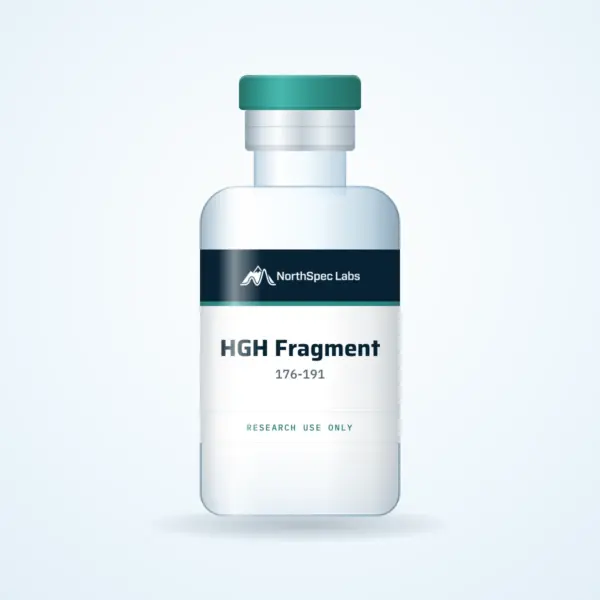
Buy HGH Fragment 176-191 5 mg in Canada
NorthSpecLabs sells HGH Fragment 176-191 in Canada in 5 mg vials, for laboratory research use only. The main points are in the table, and each one links to the detail further down the page.
| What it is | Synthetic fragment of human growth hormone |
|---|---|
| Research on this page | 4 topics, 7 references |
| Size | 5 mg |
| Purity and lab report | [TO CONFIRM: from the supplier] Details |
| Delivery | Canada Post, usually 2 to 10 business days, from our Canadian facility. Free shipping from $250. Storage, handling and shipping |
| Tool | Peptide calculator |
What is HGH Fragment 176-191?
HGH Fragment 176-191 is a synthetic peptide named after amino acids 176 to 191 of human growth hormone (hGH). PubChem has a record under this name, which describes an acetate salt form[1]. A 2026 critical review of peptide use in sport and bodybuilding names “Frag 176-191” as an example of a synthetic fragment[2].
Published research in the sources reviewed for this page is limited, and none of the sources cited here tested the 176-191 peptide itself. The laboratory studies used a peptide that is one amino acid shorter, hGH 177-191 (also called AOD9401)[3], or AOD9604, which a 2015 paper describes as the 177-191 fragment with an additional tyrosine residue at the N-terminus (the start of the chain)[4].
How HGH Fragment 176-191 works
None of the sources cited on this page tested the 176-191 peptide itself, so its own mechanism is not described here. For AOD9401 (hGH 177-191), a 2000 study reported that in isolated rat fat tissue it stimulated hormone-sensitive lipase (an enzyme that breaks down stored fat) and inhibited acetyl CoA carboxylase (an enzyme used to make fat), in a similar manner to intact hGH[3].
HGH Fragment 176-191 research applications
Published research in the sources reviewed for this page is limited, and none of it tested the 176-191 peptide itself. The laboratory studies were done in obese mice and rats with a closely related, slightly shorter peptide.
The 177-191 fragment in obese mice
A 1994 study looked at long-term treatment of obese (ob/ob) mice with a synthetic hGH 177-191 peptide[5]. The authors reported that it reduced cumulative body weight gain, decreased adipose (fat) tissue mass and significantly inhibited lipogenesis (the making of new fat) in adipose tissue[5].
AOD9401 (hGH 177-191) in obese rats
A 2000 study treated obese Zucker rats with AOD9401 for 20 days and reported reduced body weight gain and smaller fat cells, with the average cell diameter falling from 110 to 80 micrometres[3]. Unlike hGH, AOD9401 did not induce insulin resistance or glucose intolerance in the animals after chronic treatment[3].
Early synthesis of the fragments
A 1979 paper reported the synthesis of three peptides from the C-terminal region (the end of the chain) of hGH, HGH-(177-191), HGH-(178-191) and HGH-(179-191), and reported on their diabetogenic (diabetes-promoting) activities[6]. The data indicated that extending HGH-(179-191) at its NH2-terminus (the start of the chain) was required for activity in living animals[6].
Use in sport and bodybuilding
The 2026 review states that the clinical evidence supporting peptide use in sport is limited[2]. It lists potential risks highlighted by emerging data, including cardiovascular strain, insulin resistance, dyslipidemia (abnormal blood fats) and psychiatric instability, and notes that products from the largely unregulated supply chain are often mislabelled or contaminated[2]. It describes peptides as experimental substances with poorly defined long-term risks[2].
Open a topic to read what the studies reported. A number in square brackets points to a source in the reference list at the end of the page.
HGH Fragment 176-191 purity and certificate of analysis
A certificate of analysis (COA) is the lab report for one batch. It lists the tests done on that batch and their results.
[TO CONFIRM: purity, test method and batch certificate of analysis for this product, from the supplier. Once confirmed, this section shows the batch number and a link to the lab report.]
See also the lab reports (COA) page.
Why buy HGH Fragment 176-191 from NorthSpecLabs
- Every research statement on this page is tied to a published source, listed under References.
- The page says whether a study was done in cells, in animals or in people.
- Orders ship from our Canadian facility to every province and territory, with free shipping from $250.
[TO CONFIRM: third-party testing and a lab report for every batch. These points are added here once they are confirmed.]
Related: Metabolic peptides, lab supplies and the Learn pages.
Storage, handling and shipping
Storage conditions for each batch are stated on the vial label and on its certificate of analysis. [TO CONFIRM: storage statement from the supplier.]
As general guidance for dry (lyophilized) peptides, the peptide manufacturer Bachem recommends storing them in tightly closed containers below −15 °C, and letting a cold container reach room temperature in a desiccator before it is opened. Bachem also notes that long-term storage of peptide solutions is not recommended[7].
To work out the concentration of a solution, use the peptide calculator. It does the arithmetic only.
Orders ship from our Canadian facility to every province and territory, in an insulated box with gel ice packs. They leave 1 to 2 business days after payment arrives, and Canada Post usually takes 2 to 10 business days. Every order gets a tracking number by email. See also Shipping and returns.
Regulatory status
NorthSpecLabs sells HGH Fragment 176-191 for laboratory research use only. This product has not been reviewed or authorized by Health Canada for use in humans or animals.
Questions and answers
What is HGH Fragment 176-191?
HGH Fragment 176-191 is a synthetic peptide named after amino acids 176 to 191 of human growth hormone. The studies summarized on this page used a shorter fragment (177-191) or the related peptide AOD9604, not the 176-191 peptide itself.
Is HGH Fragment 176-191 approved for human use?
No. NorthSpecLabs sells HGH Fragment 176-191 for laboratory research use only, and this product has not been reviewed or authorized by Health Canada for use in humans or animals.
What has HGH Fragment 176-191 research studied?
The sources cited on this page did not test the 176-191 peptide itself. They studied the shorter 177-191 fragment (AOD9401) in obese mice and rats, where the authors reported lower body weight gain and changes in fat tissue. A 2026 review states that the clinical evidence supporting peptide use in sport is limited.
How does HGH Fragment 176-191 differ from AOD9604?
A 2015 paper describes AOD9604 as the growth hormone fragment 177-191 with an additional tyrosine residue at the start of the chain. HGH Fragment 176-191 is named after amino acids 176 to 191 of growth hormone itself. NorthSpecLabs lists them as separate products.
What is the molecular weight of HGH Fragment 176-191?
PubChem’s record under this name is an acetate salt form, with the molecular formula C80H127N23O24S2 and a molecular weight of 1859.1 g/mol (PubChem CID 172966176).
What sizes of HGH Fragment 176-191 does NorthSpecLabs carry?
5 mg vials.
Does NorthSpecLabs provide dosing or usage instructions?
No. Products are sold for laboratory research use only. NorthSpecLabs does not provide dosing, administration or medical advice.
Compound details
Names, type and molecular data
| Compound | HGH Fragment 176-191 |
|---|---|
| Also known as | Frag 176-191 |
| Type | Synthetic peptide fragment of human growth hormone |
| Molecular formula | C80H127N23O24S2 (acetate salt form) |
| Molecular weight | 1859.1 g/mol (acetate salt form) |
| CAS number | None listed in PubChem |
| PubChem CID | 172966176 |
| Related peptide in the literature | hGH (177-191), also called AOD-9401: one residue shorter (PubChem CID 25078169) |
| Sizes | 5 mg |
Molecular data are from PubChem. Follow the CID link to check them.
References
- PubChem. HGH Fragment 176-191, compound summary for CID 172966176. National Center for Biotechnology Information. Open source
- Coutinho LFD, DE Oliveira Neves LF, Camilo RP. A new era of doping? Use of peptide and peptide-analog drugs in recreational and professional sport and bodybuilding: a critical review. J Sports Med Phys Fitness. 2026;66(7):880-885. PubMed 41880199
- Ng FM, Jiang WJ, Gianello R, et al. Molecular and cellular actions of a structural domain of human growth hormone (AOD9401) on lipid metabolism in Zucker fatty rats. J Mol Endocrinol. 2000;25(3):287-98. PubMed 11116208
- Cox HD, Smeal SJ, Hughes CM, et al. Detection and in vitro metabolism of AOD9604. Drug Test Anal. 2015;7(1):31-8. PubMed 25208511
- Natera SH, Jiang WJ, Ng FM. Reduction of cumulative body weight gain and adipose tissue mass in obese mice: response to chronic treatment with synthetic hGH 177-191 peptide. Biochem Mol Biol Int. 1994;33(5):1011-21. PubMed 7987248
- Wade JD, Ng FM, Bornstein J. Diabetogenic action of human growth hormone. Synthesis and activity of C-terminal fragments. Int J Pept Protein Res. 1979;13(2):195-200. PubMed 429095
- Bachem. Handling and Storage Guidelines for Peptides. Bachem Knowledge Center. Open source
Last reviewed: October 4, 2026. This page summarises published research. It is not medical advice.
Reviews
There are no reviews yet.