
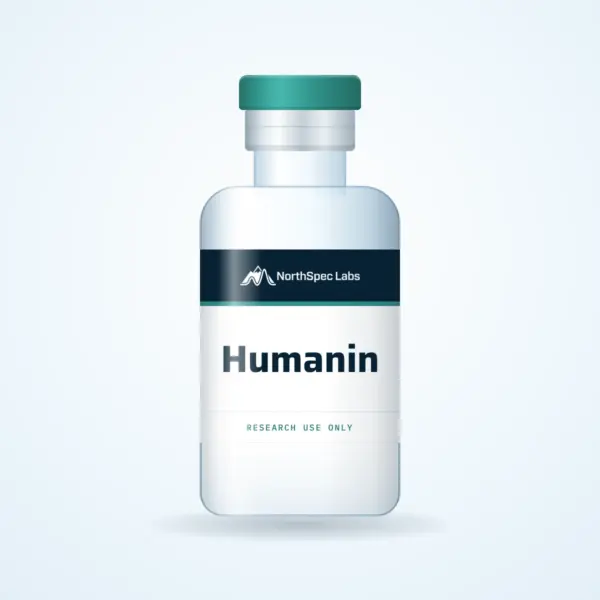
Buy Humanin 10 mg in Canada
NorthSpecLabs sells Humanin in Canada in 10 mg vials, for laboratory research use only. The main points are in the table, and each one links to the detail further down the page.
| What it is | Mitochondrial-derived peptide of 24 amino acids |
|---|---|
| Research on this page | 3 topics, 9 references |
| Size | 10 mg |
| Purity and lab report | [TO CONFIRM: from the supplier] Details |
| Delivery | Canada Post, usually 2 to 10 business days, from our Canadian facility. Free shipping from $250. Storage, handling and shipping |
| Tool | Peptide calculator |
What is Humanin?
Humanin is a peptide of 24 amino acids, with the sequence H-Met-Ala-Pro-Arg-Gly-Phe-Ser-Cys-Leu-Leu-Leu-Leu-Thr-Ser-Glu-Ile-Asp-Leu-Pro-Val-Lys-Arg-Arg-Ala-OH[1]. It belongs to a group of peptides called mitochondrial-derived peptides, which are encoded by mitochondrial DNA[2].
A 2023 review states that humanin was first reported in the early 2000s as a new factor that rescued neuronal cells from death induced by various Alzheimer's disease-associated insults[2]. In a 2001 paper, the authors identified a gene they designated Humanin, which encodes a short polypeptide that abolished death of neuronal cells caused by several types of familial Alzheimer's disease genes and by Abeta amyloid[3].
How Humanin works
A 2023 systematic review described humanin as having a cytoprotective (cell-protecting) role in preserving mitochondrial function and cell viability under stressful and senescence (cellular aging) conditions[4]. The authors also stated that both senescence and humanin-related mechanisms are complex and have not been fully clarified, and that further research is needed[4].
Humanin research applications
Most of the experiments cited here were done in cells and mice. The two human studies cited measured humanin levels in the body and did not test humanin as a treatment.
Inflammation models
In a mouse model of acute peritonitis (inflammation of the abdominal lining), preventive administration of humanin reduced leukocyte (white blood cell) infiltration and the secretion of pro-inflammatory cytokines (inflammatory signalling proteins)[5]. The authors also reported that humanin dampened pro-inflammatory cytokine secretion in primary human neutrophils (a type of leukocyte)[5].
Diabetes model in mice
In 40 adult male Balb/C mice, humanin treatment after streptozotocin-induced diabetes significantly increased total antioxidant status and glutathione levels and reduced total oxidant status in seminal vesicle fluid, compared with the diabetic group without humanin[6]. Testicular tissue changes seen in the diabetic mice, including loss of germ cells, were significantly lessened after humanin treatment, and the authors said further studies are required to validate the findings in broader experimental settings[6].
Human studies
In a randomized trial of 55 men with impaired glucose regulation, humanin protein in skeletal muscle increased by 35% after 12 weeks of resistance training, and no change in serum humanin was seen in any of the intervention groups[7]. In a randomized controlled trial of exercise in 95 patients with mild to moderate Alzheimer's disease, humanin was measured in neuron-derived extracellular vesicles from blood plasma at baseline and 16 weeks[8]. Humanin levels in these vesicles increased in the exercise group and remained unchanged in the control group[8].
Open a topic to read what the studies reported. A number in square brackets points to a source in the reference list at the end of the page.
Humanin purity and certificate of analysis
A certificate of analysis (COA) is the lab report for one batch. It lists the tests done on that batch and their results.
[TO CONFIRM: purity, test method and batch certificate of analysis for this product, from the supplier. Once confirmed, this section shows the batch number and a link to the lab report.]
See also the lab reports (COA) page.
Why buy Humanin from NorthSpecLabs
- Every research statement on this page is tied to a published source, listed under References.
- The page says whether a study was done in cells, in animals or in people.
- Orders ship from our Canadian facility to every province and territory, with free shipping from $250.
[TO CONFIRM: third-party testing and a lab report for every batch. These points are added here once they are confirmed.]
Related: Immune peptides, lab supplies and the Learn pages.
Storage, handling and shipping
Storage conditions for each batch are stated on the vial label and on its certificate of analysis. [TO CONFIRM: storage statement from the supplier.]
As general guidance for dry (lyophilized) peptides, the peptide manufacturer Bachem recommends storing them in tightly closed containers below −15 °C, and letting a cold container reach room temperature in a desiccator before it is opened. Bachem also notes that long-term storage of peptide solutions is not recommended[9].
To work out the concentration of a solution, use the peptide calculator. It does the arithmetic only.
Orders ship from our Canadian facility to every province and territory, in an insulated box with gel ice packs. They leave 1 to 2 business days after payment arrives, and Canada Post usually takes 2 to 10 business days. Every order gets a tracking number by email. See also Shipping and returns.
Regulatory status
NorthSpecLabs sells Humanin for laboratory research use only. This product has not been reviewed or authorized by Health Canada for use in humans or animals.
Questions and answers
What is humanin?
Humanin is a mitochondrial-derived peptide of 24 amino acids. It has been studied mainly in cells and mice.
Is humanin approved for human use?
No. NorthSpecLabs sells humanin for laboratory research use only, and this product has not been reviewed or authorized by Health Canada for use in humans or animals.
What has humanin research studied?
Neuronal cell death linked to Alzheimer's disease in cells, inflammation in mice and human neutrophils, and diabetes-related tissue damage in mice. The two human studies cited measured humanin levels in muscle and blood plasma, and did not test humanin as a treatment.
What is the sequence and molecular weight of humanin?
The sequence is H-Met-Ala-Pro-Arg-Gly-Phe-Ser-Cys-Leu-Leu-Leu-Leu-Thr-Ser-Glu-Ile-Asp-Leu-Pro-Val-Lys-Arg-Arg-Ala-OH / MAPRGFSCLLLLTSEIDLPVKRRA. The molecular formula is C119H204N34O32S2 and the molecular weight is 2687.2 g/mol (PubChem CID 16131438).
What sizes of humanin does NorthSpecLabs carry?
10 mg vials.
Does NorthSpecLabs provide dosing or usage instructions?
No. Products are sold for laboratory research use only. NorthSpecLabs does not provide dosing, administration or medical advice.
Compound details
Names, type and molecular data
| Compound | Humanin |
|---|---|
| Also known as | HN, Protein Humanin (human), 1-24-Protein humanin |
| Type | Mitochondrial-derived peptide, 24 amino acids |
| Sequence | H-Met-Ala-Pro-Arg-Gly-Phe-Ser-Cys-Leu-Leu-Leu-Leu-Thr-Ser-Glu-Ile-Asp-Leu-Pro-Val-Lys-Arg-Arg-Ala-OH / MAPRGFSCLLLLTSEIDLPVKRRA |
| Molecular formula | C119H204N34O32S2 |
| Molecular weight | 2687.2 g/mol |
| CAS number | 330936-69-1 |
| PubChem CID | 16131438 |
| Sizes | 10 mg |
Molecular data are from PubChem. Follow the CID link to check them.
References
- PubChem. Humanin, compound summary for CID 16131438. National Center for Biotechnology Information. Open source
- Karachaliou CE, Livaniou E. Neuroprotective Action of Humanin and Humanin Analogues: Research Findings and Perspectives. Biology (Basel). 2023;12(12). PubMed 38132360
- Hashimoto Y, Niikura T, Tajima H, et al. A rescue factor abolishing neuronal cell death by a wide spectrum of familial Alzheimer's disease genes and Abeta. Proc Natl Acad Sci U S A. 2001;98(11):6336-41. PubMed 11371646
- Coradduzza D, Congiargiu A, Chen Z, et al. Humanin and Its Pathophysiological Roles in Aging: A Systematic Review. Biology (Basel). 2023;12(4). PubMed 37106758
- Maraux M, Vetter M, Zuffo LD, et al. HUMANIN produced by human efferocytic macrophages promotes the resolution of inflammation. Cell Death Dis. 2025;16(1):656. PubMed 40877234
- Hekim MG, Kaya Tektemur N, Ozcan M. Humanin ameliorates diabetes-induced testicular damage in a streptozotocin-induced mouse model. Exp Physiol. 2026;111(10):4498-4506. PubMed 42438323
- Gidlund EK, von Walden F, Venojärvi M, et al. Humanin skeletal muscle protein levels increase after resistance training in men with impaired glucose metabolism. Physiol Rep. 2016;4(23). PubMed 27923980
- Delgado-Peraza F, Nogueras-Ortiz C, Simonsen AH, et al. Neuron-derived extracellular vesicles in blood reveal effects of exercise in Alzheimer's disease. Alzheimers Res Ther. 2023;15(1):156. PubMed 37730689
- Bachem. Handling and Storage Guidelines for Peptides. Bachem Knowledge Center. Open source
Last reviewed: October 3, 2026. This page summarises published research. It is not medical advice.
Reviews
There are no reviews yet.