
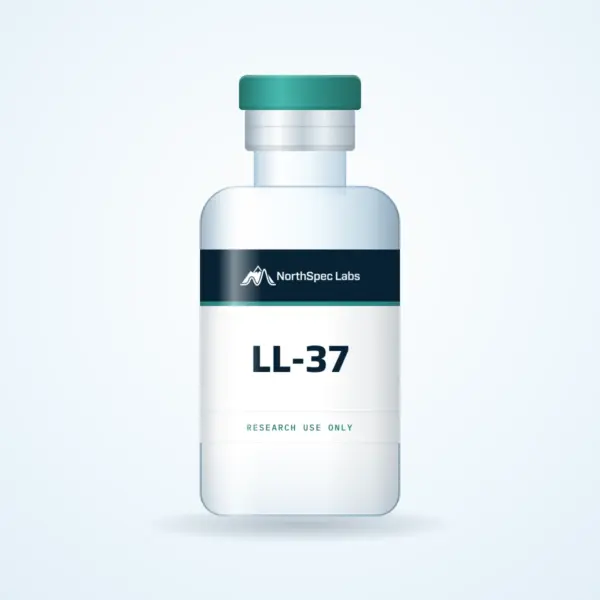
Buy LL-37 5 mg in Canada
NorthSpecLabs sells LL-37 in Canada in 5 mg vials, for laboratory research use only. The main points are in the table, and each one links to the detail further down the page.
| What it is | Cathelicidin peptide of 37 amino acids |
|---|---|
| Research on this page | 4 topics, 9 references |
| Size | 5 mg |
| Purity and lab report | [TO CONFIRM: from the supplier] Details |
| Delivery | Canada Post, usually 2 to 10 business days, from our Canadian facility. Free shipping from $250. Storage, handling and shipping |
| Tool | Peptide calculator |
What is LL-37?
LL-37 is a peptide of 37 amino acids with the sequence LLGDFFRKSKEKIGKEFKRIVQRIKDFLRNLVPRTES[1]. It is the C-terminal peptide of the human cathelicidin antimicrobial peptide (CAMP, also written hCAP18)[2].
A 2016 review described LL-37 as a paradigm for the many roles that peptides play in host defence[3]. The studies cited on this page used laboratory assays, cells, mice and human tissue samples, and two of them are reviews. None of them reported giving LL-37 to people.
How LL-37 works
A 2016 review listed direct antimicrobial activity and a role in organizing the immune response to infection among the reported activities of LL-37[3]. It reported that LL-37 can locally modulate inflammation, both enhancing it to aid in combating infection and limiting it to prevent damage to infected tissues[3]. The review also listed the promotion of angiogenesis (formation of new blood vessels) and wound healing[3].
LL-37 research applications
Published research on LL-37 includes laboratory studies, experiments in mice and analyses of human tissue samples. The studies cited here did not give LL-37 to people.
Antibacterial activity in the laboratory
A 1996 study that sequenced the human gene FALL39 reported that mature LL-37 is a potent antibacterial peptide[4]. In a 1998 laboratory study, LL-37 was generally less potent than the peptide PG-1 but showed considerable activity against bacteria including Pseudomonas aeruginosa, Escherichia coli and Staphylococcus aureus[5]. Some organisms, including methicillin-resistant S. aureus, were resistant in media that contained sodium chloride (salt) but susceptible in low-salt media[5].
Cancer research reviews
A 2018 review reported that LL-37 had tumorigenic effects (effects that tend to produce tumours) in cancers of the ovary, lung, breast, prostate and pancreas, and anti-cancer effects in colon cancer, gastric cancer, hematologic malignancy and oral squamous cell carcinoma[2].
Wound models in mice
In a mouse model of pressure ulcers, the ulcer area was significantly lower in mice that received LL-37 in a chitosan hydrogel (a gel commonly used as a base for wound dressings) than in the three comparison groups on days 11, 13 and 15[6]. In diabetic mice, a 2026 study reported that LL-37 combined with adipose-derived stem cells (ADSCs) promoted wound healing more than either treatment alone[7].
Human tissue and clinical samples
A 1997 study reported up-regulation of the human gene for LL-37 in inflammatory skin disorders, whereas no induction was found in normal skin[8]. In a 2026 study, analysis of clinical samples from diabetic and non-diabetic patients found impaired healing in human diabetic wounds that was associated with a deficiency in CAMP, the precursor of LL-37[7].
Open a topic to read what the studies reported. A number in square brackets points to a source in the reference list at the end of the page.
LL-37 purity and certificate of analysis
A certificate of analysis (COA) is the lab report for one batch. It lists the tests done on that batch and their results.
[TO CONFIRM: purity, test method and batch certificate of analysis for this product, from the supplier. Once confirmed, this section shows the batch number and a link to the lab report.]
See also the lab reports (COA) page.
Why buy LL-37 from NorthSpecLabs
- Every research statement on this page is tied to a published source, listed under References.
- The page says whether a study was done in cells, in animals or in people.
- Orders ship from our Canadian facility to every province and territory, with free shipping from $250.
[TO CONFIRM: third-party testing and a lab report for every batch. These points are added here once they are confirmed.]
Related: Immune peptides, lab supplies and the Learn pages.
Storage, handling and shipping
Storage conditions for each batch are stated on the vial label and on its certificate of analysis. [TO CONFIRM: storage statement from the supplier.]
As general guidance for dry (lyophilized) peptides, the peptide manufacturer Bachem recommends storing them in tightly closed containers below −15 °C, and letting a cold container reach room temperature in a desiccator before it is opened. Bachem also notes that long-term storage of peptide solutions is not recommended[9].
To work out the concentration of a solution, use the peptide calculator. It does the arithmetic only.
Orders ship from our Canadian facility to every province and territory, in an insulated box with gel ice packs. They leave 1 to 2 business days after payment arrives, and Canada Post usually takes 2 to 10 business days. Every order gets a tracking number by email. See also Shipping and returns.
Regulatory status
NorthSpecLabs sells LL-37 for laboratory research use only. This product has not been reviewed or authorized by Health Canada for use in humans or animals.
Questions and answers
What is LL-37?
LL-37 is a peptide of 37 amino acids. It is the C-terminal peptide of the human cathelicidin antimicrobial peptide (CAMP) and has been studied in laboratory assays, mouse wound models and human tissue samples.
Is LL-37 approved for human use?
No. NorthSpecLabs sells LL-37 for laboratory research use only, and this product has not been reviewed or authorized by Health Canada for use in humans or animals.
What has LL-37 research studied?
Laboratory antibacterial assays, reported roles in infection, inflammation and cancer, wound healing in mice, and LL-37 gene activity in human samples. The cited studies did not give LL-37 to people.
What is the sequence and molecular weight of LL-37?
The sequence is LLGDFFRKSKEKIGKEFKRIVQRIKDFLRNLVPRTES (37 amino acids). The molecular formula is C205H340N60O53 and the molecular weight is 4493 g/mol (PubChem CID 16198951).
What sizes of LL-37 does NorthSpecLabs carry?
5 mg vials.
Does NorthSpecLabs provide dosing or usage instructions?
No. Products are sold for laboratory research use only. NorthSpecLabs does not provide dosing, administration or medical advice.
Compound details
Names, type and molecular data
| Compound | LL-37 |
|---|---|
| Also known as | ropocamptide, cathelicidin LL-37, antimicrobial peptide LL-37, antibacterial peptide LL-37 |
| Type | Peptide, 37 amino acids |
| Sequence | H-Leu-Leu-Gly-Asp-Phe-Phe-Arg-Lys-Ser-Lys-Glu-Lys-Ile-Gly-Lys-Glu-Phe-Lys-Arg-Ile-Val-Gln-Arg-Ile-Lys-Asp-Phe-Leu-Arg-Asn-Leu-Val-Pro-Arg-Thr-Glu-Ser-OH (LLGDFFRKSKEKIGKEFKRIVQRIKDFLRNLVPRTES) |
| Molecular formula | C205H340N60O53 |
| Molecular weight | 4493 g/mol |
| CAS number | 154947-66-7 |
| PubChem CID | 16198951 |
| Sizes | 5 mg |
Molecular data are from PubChem. Follow the CID link to check them.
References
- PubChem. LL-37, compound summary for CID 16198951. National Center for Biotechnology Information. Open source
- Chen X, Zou X, Qi G, et al. Roles and Mechanisms of Human Cathelicidin LL-37 in Cancer. Cell Physiol Biochem. 2018;47(3):1060-1073. PubMed 29843147
- Xhindoli D, Pacor S, Benincasa M, et al. The human cathelicidin LL-37–A pore-forming antibacterial peptide and host-cell modulator. Biochim Biophys Acta. 2016;1858(3):546-66. PubMed 26556394
- Gudmundsson GH, Agerberth B, Odeberg J, et al. The human gene FALL39 and processing of the cathelin precursor to the antibacterial peptide LL-37 in granulocytes. Eur J Biochem. 1996;238(2):325-32. PubMed 8681941
- Turner J, Cho Y, Dinh NN, et al. Activities of LL-37, a cathelin-associated antimicrobial peptide of human neutrophils. Antimicrob Agents Chemother. 1998;42(9):2206-14. PubMed 9736536
- Yang X, Guo JL, Han J, et al. Chitosan hydrogel encapsulated with LL-37 peptide promotes deep tissue injury healing in a mouse model. Mil Med Res. 2020;7(1):20. PubMed 32321591
- Wei L, Wang L, Zhong F, et al. Combinatorial therapy of LL-37 and ADSCs accelerates diabetic wound repair by orchestrating NRROS-mediated crosstalk between TGF-β/SMAD and hippo/TEAD1 axes. Cytokine. 2026;207:157203. PubMed 42641316
- Frohm M, Agerberth B, Ahangari G, et al. The expression of the gene coding for the antibacterial peptide LL-37 is induced in human keratinocytes during inflammatory disorders. J Biol Chem. 1997;272(24):15258-63. PubMed 9182550
- Bachem. Handling and Storage Guidelines for Peptides. Bachem Knowledge Center. Open source
Last reviewed: October 3, 2026. This page summarises published research. It is not medical advice.
Reviews
There are no reviews yet.