
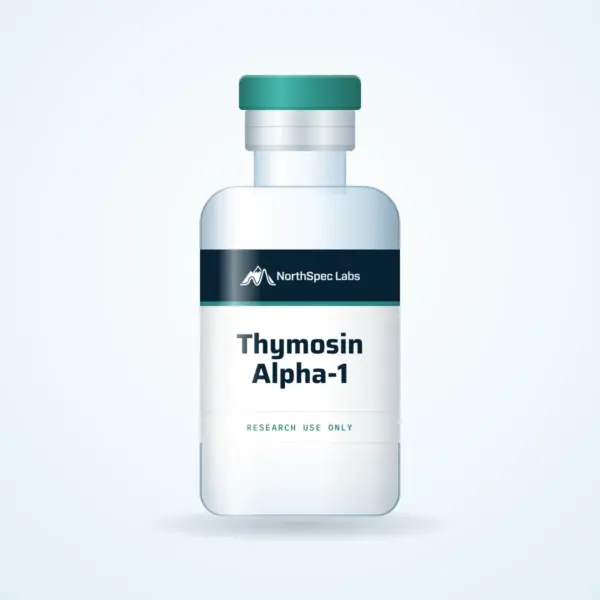
Buy Thymosin Alpha-1 in Canada
NorthSpecLabs sells Thymosin Alpha-1 in Canada in 5 mg and 10 mg vials, for laboratory research use only. The main points are in the table, and each one links to the detail further down the page.
| What it is | Peptide of 28 amino acids, also called thymalfasin |
|---|---|
| Research on this page | 4 topics, 10 references |
| Sizes | 5 mg, 10 mg |
| Purity and lab report | [TO CONFIRM: from the supplier] Details |
| Delivery | Canada Post, usually 2 to 10 business days, from our Canadian facility. Free shipping from $250. Storage, handling and shipping |
| Tool | Peptide calculator |
What is Thymosin Alpha-1?
Thymosin alpha-1, also called thymalfasin, is a peptide of 28 amino acids[1]. Its sequence in one-letter code is SDAAVDTSSEITTKDLKEKKEVVEEAEN[2]. A 2019 review describes it as an endogenous peptide, one the body makes itself, first isolated from thymic tissue in the mid-sixties[3]. A 2004 review says it is produced synthetically but was originally isolated from thymosin fraction 5, a bovine thymus extract containing a number of immunologically active peptides[1].
Clinical trials cited on this page tested it in chronic hepatitis B and C and in sepsis, often together with other treatment. A 2001 review described the results of hepatitis trials as mixed[4].
How Thymosin Alpha-1 works
Thymosin alpha-1 is described as an immunomodulating agent, a substance that adjusts the activity of the immune system, able to enhance the Th1 immune response[5]. A 2001 review says it is thought to work by augmenting T-cell function, and that it may affect thymocytes (immature T cells) by stimulating their differentiation or by converting them to active T cells[4].
In laboratory studies it influenced T-cell production and maturation, stimulated the production of Th1 cytokines such as interferon-gamma and interleukin-2, and activated the cell-killing activity of natural killer cells[1]. A 2010 review also describes a direct antiviral mechanism of action[6].
Thymosin Alpha-1 research applications
Most of the evidence comes from clinical trials in chronic hepatitis and in sepsis, and from laboratory and animal studies of the immune system. Several trials gave thymosin alpha-1 together with other drugs.
Chronic hepatitis B
A 2004 review reported that seven randomized controlled studies of thymosin alpha-1 on its own in chronic hepatitis B found a significantly higher sustained response rate than in untreated controls[1].
Chronic hepatitis C
In a large phase III randomized study in Europe, in hepatitis C patients who had not responded to peginterferon with ribavirin, thymalfasin did not improve the rate of sustained virological response[6]. In the patients who completed therapy, it significantly reduced the relapse rate[6].
Sepsis
In a 2025 phase 3, double-blind, placebo-controlled trial at 22 centres in China, 1106 adults with sepsis were assigned to thymosin alpha-1 or placebo[7]. Death from any cause within 28 days occurred in 23.4% of the thymosin alpha-1 group and 24.1% of the placebo group, and the authors found no clear evidence that it decreases mortality[7]. A smaller 2009 trial in 56 patients with sepsis gave thymosin alpha-1 together with ulinastatin and reported 78% cumulative survival, against 60% with placebo; the authors said the finding should be verified in larger trials[8].
Cancer
A 2019 review describes its use in cancer, in particular melanoma, hepatocellular carcinoma and lung cancer, often in combination with other chemo- and immune therapies[3]. In a 2024 laboratory study, thymosin alpha-1 reprogrammed tumour-associated macrophages (immune cells in tumours) toward an anti-tumour state, and it strengthened the anti-tumour effect of an oncolytic (tumour-destroying) adenovirus through CD8+ T cells[9].
Open a topic to read what the studies reported. A number in square brackets points to a source in the reference list at the end of the page.
Thymosin Alpha-1 purity and certificate of analysis
A certificate of analysis (COA) is the lab report for one batch. It lists the tests done on that batch and their results.
[TO CONFIRM: purity, test method and batch certificate of analysis for this product, from the supplier. Once confirmed, this section shows the batch number and a link to the lab report.]
See also the lab reports (COA) page.
Why buy Thymosin Alpha-1 from NorthSpecLabs
- Every research statement on this page is tied to a published source, listed under References.
- The page says whether a study was done in cells, in animals or in people.
- Orders ship from our Canadian facility to every province and territory, with free shipping from $250.
[TO CONFIRM: third-party testing and a lab report for every batch. These points are added here once they are confirmed.]
Related: Immune peptides, lab supplies and the Learn pages.
Storage, handling and shipping
Storage conditions for each batch are stated on the vial label and on its certificate of analysis. [TO CONFIRM: storage statement from the supplier.]
As general guidance for dry (lyophilized) peptides, the peptide manufacturer Bachem recommends storing them in tightly closed containers below −15 °C, and letting a cold container reach room temperature in a desiccator before it is opened. Bachem also notes that long-term storage of peptide solutions is not recommended[10].
To work out the concentration of a solution, use the peptide calculator. It does the arithmetic only.
Orders ship from our Canadian facility to every province and territory, in an insulated box with gel ice packs. They leave 1 to 2 business days after payment arrives, and Canada Post usually takes 2 to 10 business days. Every order gets a tracking number by email. See also Shipping and returns.
Regulatory status
NorthSpecLabs sells Thymosin Alpha-1 for laboratory research use only. This product has not been reviewed or authorized by Health Canada for use in humans or animals.
A 2001 review described thymosin alpha-1 as a drug then in phase III trials for the treatment of hepatitis C and in phase II trials for hepatitis B[4].
Questions and answers
What is thymosin alpha-1?
Thymosin alpha-1, also called thymalfasin, is a peptide of 28 amino acids. It was first isolated from thymus tissue and is now produced synthetically.
What does thymosin alpha-1 do?
It is described as an immunomodulating agent. Reviews say it is thought to work by augmenting T-cell function, and laboratory studies found effects on T-cell maturation, on cytokine production and on natural killer cells.
Is thymosin alpha-1 approved for human use?
NorthSpecLabs sells Thymosin Alpha-1 for laboratory research use only. This product has not been reviewed or authorized by Health Canada for use in humans or animals.
What has thymosin alpha-1 research studied?
Mainly the immune system: clinical trials in chronic hepatitis B and C and in sepsis, and its use in cancer, often together with other treatments. The largest trial cited here, in sepsis, found no clear effect on mortality.
What is the sequence and molecular weight of thymosin alpha-1?
The sequence is Ac-Ser-Asp-Ala-Ala-Val-Asp-Thr-Ser-Ser-Glu-Ile-Thr-Thr-Lys-Asp-Leu-Lys-Glu-Lys-Lys-Glu-Val-Val-Glu-Glu-Ala-Glu-Asn-OH (SDAAVDTSSEITTKDLKEKKEVVEEAEN). The molecular formula is C129H215N33O55 and the molecular weight is 3108.3 g/mol (PubChem CID 16130571).
What sizes of thymosin alpha-1 does NorthSpecLabs carry?
5 mg and 10 mg vials.
Does NorthSpecLabs provide dosing or usage instructions?
No. Products are sold for laboratory research use only. NorthSpecLabs does not provide dosing, administration or medical advice.
Compound details
Names, type and molecular data
| Compound | Thymosin alpha-1 |
|---|---|
| Also known as | Thymalfasin, thymosin alpha 1, Tα1, TA1 |
| Type | Peptide (28 amino acids) |
| Sequence | Ac-Ser-Asp-Ala-Ala-Val-Asp-Thr-Ser-Ser-Glu-Ile-Thr-Thr-Lys-Asp-Leu-Lys-Glu-Lys-Lys-Glu-Val-Val-Glu-Glu-Ala-Glu-Asn-OH (SDAAVDTSSEITTKDLKEKKEVVEEAEN) |
| Molecular formula | C129H215N33O55 |
| Molecular weight | 3108.3 g/mol |
| CAS number | 62304-98-7 |
| PubChem CID | 16130571 |
| Sizes | 5 mg, 10 mg |
Molecular data are from PubChem. Follow the CID link to check them.
References
- Chien RN, Liaw YF. Thymalfasin for the treatment of chronic hepatitis B. Expert Rev Anti Infect Ther. 2004;2(1):9-16. PubMed 15482167
- PubChem. Thymalfasin, compound summary for CID 16130571. National Center for Biotechnology Information. Open source
- Costantini C, Bellet MM, Pariano M, et al. A Reappraisal of Thymosin Alpha1 in Cancer Therapy. Front Oncol. 2019;9:873. PubMed 31555601
- Ancell CD, Phipps J, Young L. Thymosin alpha-1. Am J Health Syst Pharm. 2001;58(10):879-85; quiz 886-8. PubMed 11381492
- Sjogren MH. Thymalfasin: an immune system enhancer for the treatment of liver disease. J Gastroenterol Hepatol. 2004;19 Suppl 6:S69-72. PubMed 15546253
- Ciancio A, Rizzetto M. Thymalfasin in the treatment of hepatitis B and C. Ann N Y Acad Sci. 2010;1194:141-6. PubMed 20536462
- Wu J, Pei F, Zhou L, et al. The efficacy and safety of thymosin α1 for sepsis (TESTS): multicentre, double blinded, randomised, placebo controlled, phase 3 trial. BMJ. 2025;388:e082583. PubMed 39814420
- Li Yumin, Chen Hao, Li Xun, et al. A new immunomodulatory therapy for severe sepsis: Ulinastatin Plus Thymosin {alpha} 1. J Intensive Care Med. 2009;24(1):47-53. PubMed 19033321
- Liu K, Kong L, Cui H, et al. Thymosin α1 reverses oncolytic adenovirus-induced M2 polarization of macrophages to improve antitumor immunity and therapeutic efficacy. Cell Rep Med. 2024;5(10):101751. PubMed 39357524
- Bachem. Handling and Storage Guidelines for Peptides. Bachem Knowledge Center. Open source
Last reviewed: October 7, 2026. This page summarises published research. It is not medical advice.
Reviews
There are no reviews yet.