
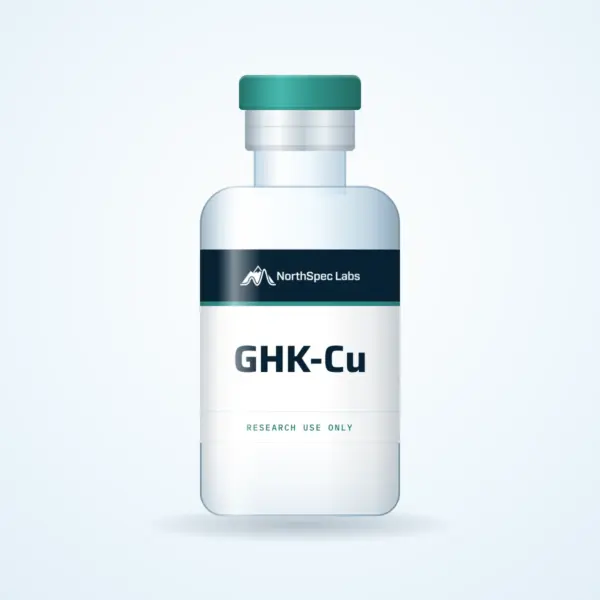
Buy GHK-Cu in Canada
NorthSpecLabs sells GHK-Cu in Canada in 50 mg and 100 mg vials, for laboratory research use only. The main points are in the table, and each one links to the detail further down the page.
| What it is | Copper complex of the tripeptide Gly-His-Lys |
|---|---|
| Research on this page | 3 topics, 7 references |
| Sizes | 50 mg, 100 mg |
| Purity and lab report | [TO CONFIRM: from the supplier] Details |
| Delivery | Canada Post, usually 2 to 10 business days, from our Canadian facility. Free shipping from $250. Storage, handling and shipping |
| Tool | Peptide calculator |
What is GHK-Cu?
GHK is a tripeptide (glycyl-L-histidyl-L-lysine) with an affinity for copper(II) ions. It was isolated from human plasma[1] and first reported in 1973[2]. GHK-Cu is the complex it forms with copper. It is also listed under the names prezatide copper and Copper Tripeptide-1[3].
A 2015 review states that GHK is present in human plasma, saliva and urine and that its level declines with age[4]. The 2015 and 2018 reviews cited on this page were written by L. Pickart, the first author of the 1973 report, and co-authors.
How GHK-Cu works
A 2015 review proposes that GHK works as a complex with copper, which speeds wound healing and skin repair[4]. According to the same review, GHK stimulates both the synthesis and the breakdown of collagen and glycosaminoglycans, and it can up- and down-regulate at least 4,000 human genes[4].
GHK-Cu research applications
Research on GHK-Cu covers cell culture, animal wound models and topical skin care in people.
Collagen in cell culture
In fibroblast cultures, GHK-Cu stimulated collagen synthesis. The effect began between 10⁻¹² and 10⁻¹¹ M, peaked at 10⁻⁹ M and was independent of any change in cell number[1].
Wound healing and skin
Reviews report that GHK increases the synthesis of collagen, elastin and glycosaminoglycans, supports the function of dermal fibroblasts[5], and speeds wound healing in animal models including rats, mice and pigs[4].
Human studies
Human studies have looked at topical skin care. In a small randomized trial after CO2 laser skin resurfacing (13 patients completed), products containing GHK-Cu gave no significant objective improvement in redness, wrinkles or overall skin quality compared with the control regimen, although patient-reported satisfaction was higher[6]. It was the only publication indexed as a randomized controlled trial in a PubMed search for GHK-Cu or copper tripeptide on October 3, 2026.
Open a topic to read what the studies reported. A number in square brackets points to a source in the reference list at the end of the page.
GHK-Cu purity and certificate of analysis
A certificate of analysis (COA) is the lab report for one batch. It lists the tests done on that batch and their results.
[TO CONFIRM: purity, test method and batch certificate of analysis for this product, from the supplier. Once confirmed, this section shows the batch number and a link to the lab report.]
See also the lab reports (COA) page.
Why buy GHK-Cu from NorthSpecLabs
- Every research statement on this page is tied to a published source, listed under References.
- The page says whether a study was done in cells, in animals or in people.
- Orders ship from our Canadian facility to every province and territory, with free shipping from $250.
[TO CONFIRM: third-party testing and a lab report for every batch. These points are added here once they are confirmed.]
Related: Longevity peptides, lab supplies and the Learn pages.
Storage, handling and shipping
Storage conditions for each batch are stated on the vial label and on its certificate of analysis. [TO CONFIRM: storage statement from the supplier.]
As general guidance for dry (lyophilized) peptides, the peptide manufacturer Bachem recommends storing them in tightly closed containers below −15 °C, and letting a cold container reach room temperature in a desiccator before it is opened. Bachem also notes that long-term storage of peptide solutions is not recommended[7].
To work out the concentration of a solution, use the peptide calculator. It does the arithmetic only.
Orders ship from our Canadian facility to every province and territory, in an insulated box with gel ice packs. They leave 1 to 2 business days after payment arrives, and Canada Post usually takes 2 to 10 business days. Every order gets a tracking number by email. See also Shipping and returns.
Regulatory status
NorthSpecLabs sells GHK-Cu for laboratory research use only. This product has not been reviewed or authorized by Health Canada for use in humans or animals.
Questions and answers
What is GHK-Cu?
GHK-Cu is the copper(II) complex of the tripeptide glycyl-L-histidyl-L-lysine (GHK), a peptide first isolated from human plasma and reported in 1973.
Is GHK-Cu the same as Copper Tripeptide-1?
Yes. Copper Tripeptide-1 and prezatide copper are other names listed for GHK-Cu in PubChem.
Is GHK-Cu approved for human use?
No. NorthSpecLabs sells GHK-Cu for laboratory research use only, and this product has not been reviewed or authorized by Health Canada for use in humans or animals.
What has GHK-Cu research studied?
Collagen production in cell culture, wound healing in animal models, and topical skin care in small human trials.
What is the molecular weight of GHK-Cu?
PubChem lists GHK-Cu as C14H23CuN6O4 with a molecular weight of 402.92 g/mol (CID 71587328). The GHK peptide alone is C14H24N6O4, 340.38 g/mol.
What sizes of GHK-Cu does NorthSpecLabs carry?
50 mg and 100 mg vials.
Does NorthSpecLabs provide dosing or usage instructions?
No. Products are sold for laboratory research use only. NorthSpecLabs does not provide dosing, administration or medical advice.
Compound details
Names, type and molecular data
| Compound | GHK-Cu |
|---|---|
| Also known as | Prezatide copper, Copper Tripeptide-1, GHK copper |
| Type | Copper(II) complex of a tripeptide |
| Peptide sequence | Gly-His-Lys (GHK) |
| Molecular formula (GHK-Cu) | C14H23CuN6O4 |
| Molecular weight (GHK-Cu) | 402.92 g/mol |
| CAS number (GHK-Cu) | 89030-95-5 |
| PubChem CID (GHK-Cu) | 71587328 |
| GHK peptide alone | C14H24N6O4, 340.38 g/mol, CAS 49557-75-7, PubChem CID 73587 |
| Sizes | 50 mg, 100 mg |
Molecular data are from PubChem. Follow the CID link to check them.
References
- Maquart FX, Pickart L, Laurent M, et al. Stimulation of collagen synthesis in fibroblast cultures by the tripeptide-copper complex glycyl-L-histidyl-L-lysine-Cu2+. FEBS Lett. 1988;238(2):343-6. PubMed 3169264
- Pickart L, Thaler MM. Tripeptide in human serum which prolongs survival of normal liver cells and stimulates growth in neoplastic liver. Nat New Biol. 1973;243(124):85-7. PubMed 4349963
- PubChem. Prezatide copper, compound summary for CID 71587328. National Center for Biotechnology Information. Open source
- Pickart L, Vasquez-Soltero JM, Margolina A. GHK Peptide as a Natural Modulator of Multiple Cellular Pathways in Skin Regeneration. Biomed Res Int. 2015;2015:648108. PubMed 26236730
- Pickart L, Margolina A. Regenerative and Protective Actions of the GHK-Cu Peptide in the Light of the New Gene Data. Int J Mol Sci. 2018;19(7). PubMed 29986520
- Miller TR, Wagner JD, Baack BR, et al. Effects of topical copper tripeptide complex on CO2 laser-resurfaced skin. Arch Facial Plast Surg. 2006;8(4):252-9. PubMed 16847171
- Bachem. Handling and Storage Guidelines for Peptides. Bachem Knowledge Center. Open source
Last reviewed: October 3, 2026. This page summarises published research. It is not medical advice.
Reviews
There are no reviews yet.